
Search
Category
Related Industries
- China Soda Ash Producer Inventories Fall to 1.3689 Million Tonnes in Week to October 26China soda ash producer inventories fell 6.94% to 1.3689 million tonnes in the week to October 26. Explore what the drawdown means for procurement planning and supplier delivery checks.
- What determines the cost of professional REACH compliance guidance?REACH compliance guidance cost depends on substance complexity, tonnage, data gaps, and support scope. Discover hidden expenses and compare quotes to build a smarter compliance budget.
- China TDI Price Reaches RMB 40,833 per Tonne on October 25, Up 9.38% in 10 DaysChina TDI price reached RMB 40,833 per tonne on October 25, 2026, up 9.38% in 10 days. Explore market trends and procurement cost implications to inform your purchasing decisions.
Weekly Insights
Stay ahead with our curated technology reports delivered every Monday.
Which Polymer Additives Are Halogen-Free and Still Flame Retardant?




Which Polymer Additives Are Halogen-Free and Still Flame Retardant?
The short answer is: phosphorus-based, nitrogen-based, mineral-based, and intumescent additives are the main halogen-free routes to flame-retardant polymers. In practice, however, choosing among them is less straightforward than replacing one ingredient with another. A flame retardant that performs well in a glass-fiber-reinforced polyamide may cause moisture sensitivity in a polyester compound, while a mineral filler that is acceptable in a thick cable jacket can be impractical in a thin-wall electronic housing.
That is why the question, “Which polymer additives are halogen-free and still flame retardant?” should be answered through formulation behavior, processing conditions, end-use geometry, and the applicable fire test—not simply through a list of chemical names. Halogen-free flame retardancy is now a central formulation issue for plastics, rubber, coatings, wire and cable compounds, building materials, transport components, and electrical assemblies. Yet “halogen-free” does not automatically mean low smoke, low toxicity, recyclable, easy to process, or suitable for every polymer.
For compounders and product developers, the real task is to balance fire performance with mechanical retention, electrical properties, color, hydrolysis resistance, migration behavior, and commercial supply stability. This is especially relevant in polymer auxiliaries, where a few percentage points of an additive package can change the entire processing window of a resin.
The Main Families of Halogen-Free Flame Retardants
Halogen-free flame retardants work through several mechanisms. Some release water and cool the burning surface. Some form a protective char layer. Others promote condensed-phase carbonization, dilute combustible gases, or interrupt degradation pathways before ignition develops into sustained burning. The chemistry matters, but the polymer matrix matters just as much.
Phosphorus-based flame retardants
Phosphorus chemistry is one of the most versatile halogen-free options. It includes phosphate esters, phosphinate salts, phosphonate derivatives, red phosphorus preparations, ammonium polyphosphate, and polymeric phosphorus-containing materials. These chemistries are used across engineering plastics, thermosets, coatings, flexible and rigid polyurethane systems, and selected elastomer applications.
Their appeal is that many phosphorus systems can be effective at more manageable loading levels than mineral fillers. In the right resin, they encourage the formation of a carbonaceous barrier that reduces heat transfer and limits the release of volatile fuel. That makes them particularly attractive where a molded part must retain stiffness, dimensional control, or a clean surface appearance.
Still, “phosphorus-based” is far too broad to be a purchasing specification. Some grades are designed for high-temperature engineering resins; others are better suited to polyolefins, coatings, or polyurethane foam. The processor should check thermal stability against actual melt temperatures and residence times, not just a generic decomposition-temperature figure. Hydrolysis behavior also deserves attention in humid applications or polymers processed with residual moisture.
Nitrogen-based and phosphorus-nitrogen systems
Nitrogen-containing flame retardants are commonly used in melamine-related chemistry and in phosphorus-nitrogen combinations. On their own, nitrogen systems may not provide enough protection for every polymer or fire classification. Their strongest role is often synergy: nitrogen-containing components can release inert gases during thermal decomposition and support the expansion or stability of a protective char.
Ammonium polyphosphate-based intumescent formulations are a familiar example. A typical intumescent package needs an acid source, a carbon source, and a blowing agent. Under heat, the formulation creates an expanded char that shields the substrate. It can be highly useful in polypropylene, coatings, and certain construction-oriented compounds, but it is not automatically robust. Moisture pickup, inadequate dispersion, aggressive compounding shear, or poor adhesion between char and polymer can all undermine performance.
For this reason, a laboratory plaque that appears promising may not translate neatly to a thin molded component, a filled extrusion profile, or a multi-layer cable design. Flame retardancy is a system property. The substrate thickness, pigments, reinforcing fibers, impact modifiers, lubricants, and even recycled-content variability can influence the final result.
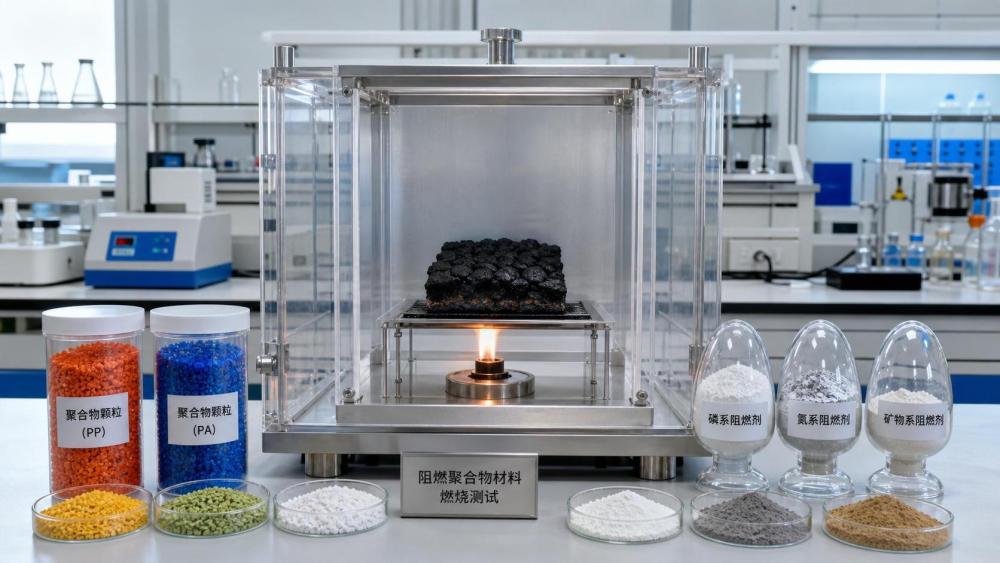
Mineral flame retardants: aluminum trihydrate and magnesium hydroxide
Aluminum trihydrate, often abbreviated ATH, and magnesium hydroxide are among the most established non-halogenated mineral flame retardants. When exposed to high heat, they decompose endothermically and release water. This absorbs heat and dilutes combustible gases near the burning surface. They are widely considered practical options in wire and cable insulation, low-smoke compound systems, roofing membranes, flooring, and some rubber applications.
The trade-off is loading. Mineral hydroxides often require relatively high incorporation levels to produce meaningful fire protection. That can raise compound viscosity, reduce elongation, complicate extrusion, and affect surface quality. A cable producer may accept this because smoke suppression and low corrosive-gas behavior are central requirements. A manufacturer of a thin, highly detailed injection-molded part may not have that freedom.
ATH generally has a lower thermal tolerance than magnesium hydroxide, so processor temperature becomes a decisive filter. It is not enough to say that a filler is “suitable for polyolefins.” The question is whether it remains stable throughout the actual compounding and conversion cycle. Surface treatment, particle size, dispersion equipment, and coupling agents also influence whether a high-filled compound stays processable.
Why Polymer Compatibility Is Usually the Deciding Factor
A recurring mistake in flame-retardant development is to start with the target fire rating and work backward from a brochure. The better starting point is the polymer’s degradation chemistry. Polypropylene, polyethylene, polyamide, polyester, polycarbonate, epoxy, TPU, EVA, PVC alternatives, and silicone rubber respond differently to heat and additives. A package that promotes char in one polymer may create drip, brittleness, plate-out, or poor color in another.
Take polypropylene as an example. It is widely used and economically attractive, but it tends to melt and drip under fire exposure. Intumescent phosphorus-nitrogen systems can be effective, provided the char forms quickly and remains coherent. Mineral hydroxides may be preferred in applications where high filler loading is acceptable. In reinforced engineering plastics, phosphinate-based systems may be considered where higher thermal stability is needed, but glass fiber content and part geometry can alter burn behavior significantly.
For polyurethane, the situation changes again. Flexible foam, rigid insulation foam, cast elastomer, and coating formulations each have different reaction and processing constraints. A flame retardant package that is compatible with a polyol blend may not be suitable for a melt-compounded thermoplastic polyurethane. Migration, fogging, and long-term aging can matter as much as initial flame test performance.
“Halogen-Free” Is Not the Same as “Compliance-Ready”
Many buyers use “halogen-free” as shorthand for a safer, more acceptable material. That shorthand can be misleading. The term may refer to the absence of intentionally added brominated or chlorinated flame retardants, but customer specifications, regional regulations, end-market declarations, and testing protocols can define requirements differently. Some applications also restrict particular phosphorus compounds, antimony-containing synergists, heavy metals, substances with certain hazard classifications, or materials that compromise recyclability.
A responsible screening process therefore needs more than a halogen declaration. It should include the additive’s safety documentation, relevant substance-status review, expected use conditions, and the applicable product standard. For electrical parts, building products, transportation components, and cable systems, the required fire test may evaluate very different behavior: ignition resistance, flame spread, heat release, smoke density, dripping, afterflame, or corrosivity of combustion gases.
UL 94, for example, is frequently referenced for plastic materials, but it is not a universal substitute for application-specific testing. A material formulation that performs at one thickness may not give the same classification at a thinner wall. Nor does a favorable vertical burn result answer every question about smoke, toxicity, or real-fire behavior. Specifications need to be read in the context of the finished part, not only the resin datasheet.
What Should Be Tested Before Selecting an Additive Package?
Before locking a formulation, teams usually need to assess more than flame performance. The most expensive failures tend to appear later: during production scale-up, in a climate-aging cycle, after pigment changes, or when a second raw-material source is introduced. A practical qualification plan should examine the properties that can realistically be affected by the additive system.
- Processing stability at actual extrusion, molding, or curing conditions.
- Mechanical retention, particularly impact strength, elongation, flex behavior, and weld-line performance.
- Color, gloss, surface appearance, and susceptibility to bloom or plate-out.
- Moisture sensitivity, hydrolysis resistance, and aging under expected environmental exposure.
- Electrical behavior where tracking resistance, dielectric strength, or insulation integrity is relevant.
- Fire testing on representative part thicknesses and construction details.
It is also wise to test the complete additive package rather than treating flame retardant, antioxidant, stabilizer, lubricant, and filler as independent choices. Antioxidants can affect discoloration and thermal stability; dispersing aids can change char formation; impact modifiers can alter burning behavior. This is where formulation intelligence becomes more valuable than a simple chemical price comparison.
How to Make a More Defensible Selection
In the polymer additives market, the lowest-cost option per kilogram is often not the lowest-cost option per finished part. A mineral-filled compound may reduce raw-material cost but require more torque, slower throughput, or equipment adjustment. A more concentrated phosphorus system may preserve processing and mechanical properties but demand tighter moisture control or more careful supplier qualification. Neither approach is inherently superior.
For buyers working across global supply chains, consistency deserves equal attention. Flame retardant performance can be sensitive to particle morphology, coating treatment, active-content variation, and impurity profile. When evaluating alternative sources, compare technical documentation, batch-control practices, and pilot-compound behavior rather than relying on a nominal chemical identity alone. This is particularly important for industrial auxiliaries supplied into regulated export markets.
BCIA’s perspective across basic chemicals, specialty solvents, polymer auxiliaries, and environmental chemistry is that flame-retardant selection should never be isolated from the rest of the formulation. The same product may face resin-quality variation upstream, moisture control during compounding, and end-of-life expectations downstream. A technically sound choice is one that can be processed reliably, tested against the right requirement, documented credibly, and supplied with enough consistency to survive commercial production.
So, which polymer additives are halogen-free and still flame retardant? Start with phosphorus-, nitrogen-, mineral-, and intumescent-based systems—but do not stop there. Match the chemistry to the polymer, test it at realistic thickness and processing conditions, and verify the full compliance profile required by the final market. In flame retardancy, the additive is only one part of the answer; the formulation is the answer.
Recommended News