
Search
Category
Related Industries
- How supply disruptions reshape chemical sourcing decisions worldwideGlobal chemical supply chain disruptions are reshaping sourcing. Explore smarter strategies for risk, compliance, dual sourcing, and resilient procurement.
- How to assess zero-carbon chemical synthesis catalysts for scale-upZero-carbon chemical synthesis catalysts: assess scale-up readiness through lifecycle emissions, durability, reactor fit, energy use, safety, and product quality.
- How to use a global chemical regulations guide for market entryUse a global chemical regulations guide to identify compliance triggers, reduce market-entry risks, and build a faster path to confident international chemical sales.
Weekly Insights
Stay ahead with our curated technology reports delivered every Monday.
How Belt and Scraper Systems Affect Poultry Manure Removal Efficiency




Why the manure transport method changes flock-house performance
In poultry housing, manure removal efficiency is rarely determined by motor power alone. The transport method underneath cages or along walkways often decides whether manure leaves the house on schedule, whether moisture stays under control, and whether labor remains predictable. Belt and scraper systems solve the same problem in different ways, but they behave very differently once floor layout, manure consistency, cleaning intervals, and building length are taken into account.
For technical evaluation teams, the important question is not which system is “better” in general. It is which mechanism matches the manure load, structural layout, ventilation pattern, maintenance capacity, and cleaning frequency of the farm. A system that performs well in a dry layer house may struggle in a wetter house with inconsistent management. Another may tolerate difficult manure conditions but demand more attention to wear parts, alignment, or discharge design.
Belt systems and scraper systems affect efficiency through four practical variables: how completely manure is collected, how often it can be removed without disruption, how much residue remains after each cycle, and how much downtime is created by jams, stretching, corrosion, or cleaning difficulties. Those variables eventually influence ammonia control, bird-house hygiene, labor use, and the operating reliability of the entire manure handling line.
How belt systems move manure and where they gain efficiency
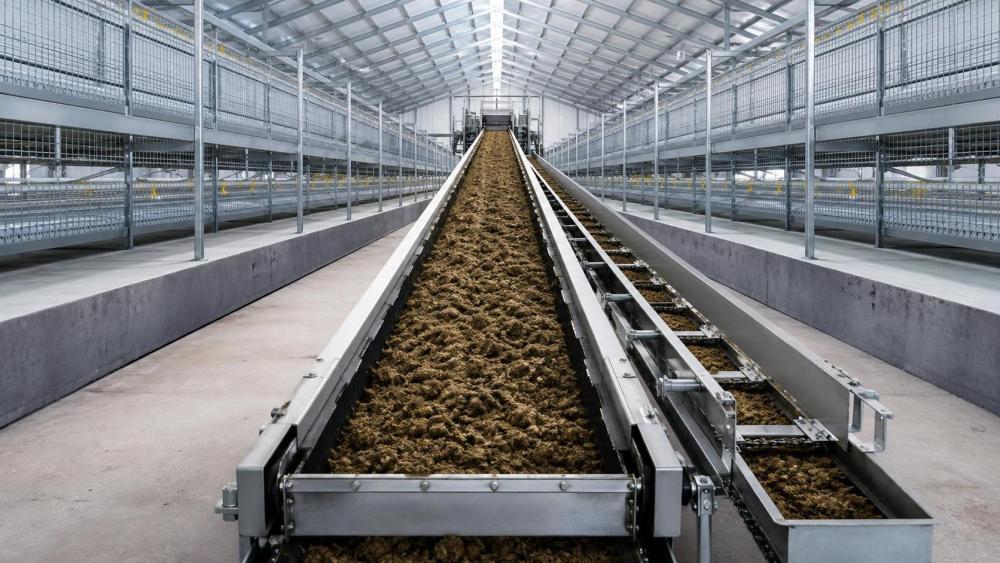
A belt system typically carries manure on a continuous or sectional belt installed under cages or along a defined channel. When the drive runs, manure is transported toward a collection point for discharge. In many cage-house layouts, this method allows manure to be removed in a relatively uniform sheet rather than pushed in intermittent piles. That difference matters because uniform transport usually reduces carryback, localized buildup, and uneven loading on the downstream conveyor.
The main efficiency advantage of a belt is consistency. When the belt surface remains properly tensioned and clean, it can remove manure with limited residual material left behind. Less residue means lower chances of repeated drying and hardening on the transport surface. It also makes scheduled operation easier, especially in houses where removal needs to happen frequently to manage moisture and indoor air quality.
Another benefit appears in longer houses where manure must travel over substantial distance. A correctly selected belt can maintain continuous flow to the discharge end without the pulsed accumulation common in push-type systems. That often improves the predictability of collection timing and downstream transfer capacity.
Still, belt performance depends heavily on details that are easy to underestimate during procurement:
- Belt material resistance to abrasion, manure acidity, and cleaning chemicals
- Tension stability over time and under seasonal temperature variation
- Tracking accuracy, especially in long runs
- Scraper or brush cleaning effectiveness at the return end
- Drive and roller sealing against corrosive moisture
If those elements are weak, the theoretical efficiency of the belt is quickly reduced by drift, slipping, edge damage, or retained manure film. In other words, a belt system tends to reward good engineering and disciplined maintenance, but it can become sensitive when installation quality is inconsistent.
How scraper systems work and why some farms still prefer them
A scraper system usually pushes manure along a channel, pit, or floor surface with a blade or drag assembly. Instead of carrying manure on a moving surface, it relies on mechanical force to move material toward a discharge zone. This design can be attractive where manure is heavier, where channels are structurally integrated into the building, or where operators prefer a rugged, relatively direct transport method.
Scraper systems often handle variable manure texture better than buyers expect. In houses where manure moisture fluctuates because of drinking line leakage, seasonal humidity, or feed-related changes in droppings consistency, a scraper may continue moving material even when a belt surface would face sticking or cleaning challenges. This does not make the scraper universally superior, but it explains why it remains common in demanding operating environments.
The tradeoff is that scrapers tend to be more influenced by floor or channel condition. Uneven surfaces, hardened deposits, sidewall wear, and obstructions can increase drag force and reduce removal completeness. If the blade does not maintain proper contact, a thin layer of residue may remain after every cycle. Over time that residue can build up and increase cleaning effort, odor, and corrosion risk.
Scraper efficiency also depends on the mechanical layout of chains, cables, winches, guides, and return paths. Wear in one part of the drive train often shows up as slower travel, incomplete scraping, or occasional overload events. The system may still run, but not at the level of efficiency assumed in a purchasing specification.
Where the efficiency gap really appears in daily operation
When comparing the two systems, buyers sometimes focus on rated capacity or installed power. Day-to-day efficiency is usually shaped by less obvious factors.
Removal completeness
A belt can leave very little residue when the manure releases cleanly from the surface and the end cleaner is properly adjusted. A scraper can also achieve good removal, but results are more sensitive to blade condition and floor flatness. In houses where dried manure adheres strongly to the base surface, the difference becomes significant because every leftover layer increases future drag or contamination.
Tolerance to manure condition changes
Scraper systems may remain functional across a wider range of manure consistencies, especially when material becomes sticky or locally compacted. Belt systems can perform extremely well with controlled moisture, but they are less forgiving if manure smears, freezes, or accumulates on rollers and return sections. Technical teams should assess not only average manure condition but the worst operating week of the year.
Cycle frequency and house environment
Frequent removal is often linked to better house hygiene and lower ammonia formation, but only if the transport system can run reliably without requiring frequent manual intervention. Belt systems are commonly favored where frequent, predictable cycles are planned. Scraper systems can also be scheduled regularly, though repetitive high-drag operation may increase wear if channels are rough or manure is not evenly distributed.
Downtime exposure
A jammed scraper is visible quickly, but the causes may include hidden channel wear or hardened deposits that keep returning. A belt may operate quietly until mistracking, stretching, or cleaner failure starts causing residue buildup and discharge problems. For efficiency evaluation, downtime should include not only full stoppages but reduced-performance operation that still consumes labor.
Layout, building type, and discharge design often decide the winner
The building itself can favor one system before any equipment comparison begins. In multi-tier cage houses, belt layouts often fit well because manure can be collected directly from each tier and transferred in an organized flow. In houses with robust channels, simpler floor geometry, or heavier manure accumulation patterns, scraper designs may integrate more naturally.
Discharge arrangement matters just as much as in-house transport. If manure leaves the belt or scraper and falls into a poorly sized cross conveyor, open heap, or transfer hopper with bridging risk, the upstream system will appear inefficient even when it is not the root cause. Evaluation should cover the full chain from collection point to final loading or storage area.
This is where a broader poultry manure removal system review becomes useful. Buyers comparing brands, specifications, and automatic removal layouts should look beyond the primary transport mechanism and check how the complete line handles transfer points, cleaning access, corrosion exposure, and maintenance intervals.
What technical evaluators should inspect before approving a system
Specification sheets rarely show the weak points that matter after installation. A stronger evaluation process usually includes the following checks.
Materials in contact with manure
Corrosion resistance is not a minor detail. Poultry manure is aggressive, especially in damp conditions. Rollers, fasteners, chains, blades, bearings, and frames should be reviewed according to where moisture and residue actually collect. Components at discharge and return ends usually face the harshest exposure.
Drive sizing under real operating load
Nominal motor power says little unless matched with startup load, manure depth, friction level, and the length of the transport path. Systems that are technically adequate in clean conditions may struggle after several weeks of partial residue buildup. Buyers should ask how the drive margin was determined for the intended house layout and cleaning schedule.
Adjustment and service access
If belt tensioning, scraper blade replacement, chain adjustment, or return-end cleaning requires excessive labor or awkward access, the system is less likely to stay in its intended operating condition. Poor serviceability quietly reduces efficiency because maintenance is delayed until performance has already dropped.
Discharge cleanliness
An efficient transport path still creates problems if manure wraps around rollers, drops outside the intended chute, or accumulates at corners. End-of-line cleanliness affects odor, insect pressure, and labor time. It is also one of the clearest signs that a system has been designed for real farm use rather than only for catalog presentation.
Common procurement mistakes that distort efficiency comparisons
One common mistake is evaluating belt and scraper systems under idealized manure conditions. Farms rarely operate under stable, dry, evenly distributed load year-round. Drinker leaks, feed changes, ventilation imbalance, and delayed cleaning all change the behavior of the material being moved.
Another mistake is separating equipment price from maintenance burden. A lower-cost system may appear competitive until blade replacement, belt tracking correction, corrosion repairs, or discharge cleanup are included in labor planning. Technical teams should compare not only purchase cost but also the effort required to keep efficiency from drifting down over time.
Some buyers also overlook installation precision. Belt alignment errors, uneven channel surfaces, and poor transfer geometry can make two identical systems perform very differently. When acceptance criteria are vague, disputes later focus on symptoms rather than root causes. It is better to define measurable acceptance points early, such as removal completeness after a cycle, visible residue limits, abnormal noise thresholds, and discharge cleanliness.
Belt vs. scraper: a practical comparison for decision-making
How to match the system to the farm instead of the brochure
If the house depends on frequent manure removal, has a layout that supports organized collection from multiple tiers, and can maintain reasonable control over moisture and cleaning discipline, a belt system often offers cleaner, more repeatable transport. If the operating environment is rougher, manure consistency is less predictable, or the structure favors channel-based movement, a scraper may provide a more forgiving mechanical approach.
The better choice usually becomes clear only after reviewing the full operating context: manure characteristics, house geometry, corrosion exposure, transfer points, available maintenance labor, and the acceptable level of residue after each cycle. Efficiency is not created by the transport mechanism alone. It comes from how well that mechanism fits the real conditions of the farm and how easily it can hold performance after months of exposure to manure, moisture, and routine wear.
For technical evaluators, that is the useful dividing line. Belt systems tend to reward precision and process control. Scraper systems tend to reward robustness and tolerance. The right selection is the one whose weak points remain manageable under the farm’s least favorable operating conditions, not the one that looks strongest in a simplified comparison.
Recommended News