
Search
Category
Related Industries
- China Soda Ash Producer Inventories Fall to 1.3689 Million Tonnes in Week to October 26China soda ash producer inventories fell 6.94% to 1.3689 million tonnes in the week to October 26. Explore what the drawdown means for procurement planning and supplier delivery checks.
- What determines the cost of professional REACH compliance guidance?REACH compliance guidance cost depends on substance complexity, tonnage, data gaps, and support scope. Discover hidden expenses and compare quotes to build a smarter compliance budget.
- China TDI Price Reaches RMB 40,833 per Tonne on October 25, Up 9.38% in 10 DaysChina TDI price reached RMB 40,833 per tonne on October 25, 2026, up 9.38% in 10 days. Explore market trends and procurement cost implications to inform your purchasing decisions.
Weekly Insights
Stay ahead with our curated technology reports delivered every Monday.
Should I Choose Custom Process Chemistry or a Standard Route?




The decision is usually not between a “good” custom route and an “adequate” standard one. It is a question of whether process development can solve a business constraint that an established route cannot solve at acceptable cost and risk.
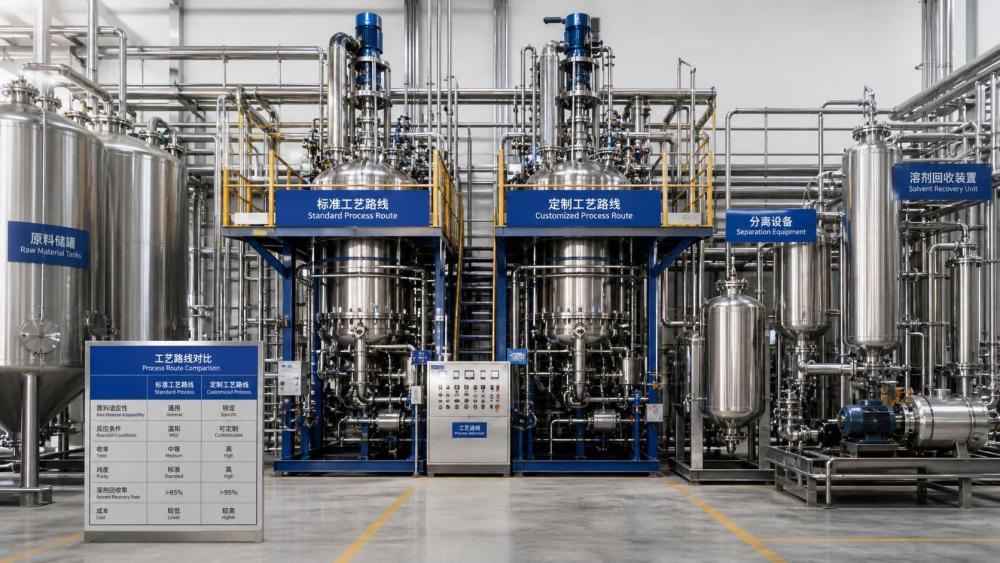
For a mature bulk intermediate with multiple qualified suppliers, a standard route is often the rational starting point. It can shorten qualification, rely on known equipment and raw materials, and make production economics easier to model. Custom process chemistry becomes more compelling when the standard route creates a persistent problem: unstable feedstock access, an impurity profile that limits downstream performance, excessive solvent or waste burden, weak intellectual-property positioning, or a scale-up path that no longer works under the required safety and compliance conditions.
The practical answer to “Should I invest in custom process chemistry development or use standard routes?” therefore depends on the size and durability of that problem. A custom route should not be funded merely because it is technically elegant. It should be funded when it can create a defensible manufacturing advantage or prevent a material commercial risk that would otherwise remain embedded in the business.
Start with the constraint, not the chemistry
Teams often begin by comparing reaction yields, catalyst options, or laboratory cycle times. Those matter, but they are rarely the first decision variable. The better opening question is: what is preventing the current or standard route from supporting the intended product and market?
For a specialty solvent, the limiting issue may be trace contamination that causes failures in electronic cleaning or pharmaceutical extraction. For a polymer additive, it may be thermal stability, color, odor, or dispersion behavior that prevents a customer from approving the material. For an agrochemical intermediate, the issue may be a difficult impurity that complicates formulation or registration work. In water-treatment chemistry, a route can be commercially weak even when it delivers nominal assay, because it produces variable molecular characteristics or contaminants that affect treatment consistency.
These are not interchangeable problems. A modest yield improvement may be valuable in a large-volume acid, alcohol, or inorganic salt operation. It may be almost irrelevant when a high-value additive loses business because its lot-to-lot profile creates uncertainty in a downstream formulation. Custom development has the strongest case when it directly changes the performance, compliance, supply, or qualification outcome that customers actually buy.
- Use a standard route when the product specification is widely understood, raw materials are dependable, the route has a credible environmental and safety record, and competition is primarily based on dependable execution and cost discipline.
- Consider a custom route when existing chemistry cannot consistently meet a required specification, depends on a vulnerable input, creates a difficult regulatory exposure, or leaves no meaningful way to distinguish the product from interchangeable alternatives.
- Pause the decision when the problem is commercial rather than technical. Process development will not fix uncertain demand, an unclear product specification, or a market unwilling to pay for a better material.
A standard route is not automatically low risk. It may carry legacy assumptions about feedstock availability, waste treatment capacity, solvent recovery, or local permitting. Conversely, a custom route is not automatically a high-cost experiment. A targeted modification, such as changing the sequence of isolation, replacing a problematic solvent, improving catalyst recovery, or controlling a critical impurity earlier in the process, can be narrower and more valuable than a full route redesign.
Where standard routes retain a real advantage
Established chemistry has advantages that are easy to underestimate during early technical discussions. A standard route often has known reaction behavior, recognized analytical methods, familiar operating procedures, existing toll-manufacturing options, and a supply base for major inputs. Those advantages shorten the path between product intent and a qualified commercial campaign.
This is especially important where the chemistry is not the buyer’s differentiator. A manufacturer purchasing a common bulk intermediate may value reliable volume, predictable specifications, documentation, and delivery continuity more than a novel synthesis pathway. In such cases, developing proprietary chemistry can consume capital and management attention without improving the buying decision.
Standard routes are also useful for market entry. They let a producer establish demand, understand application requirements, and identify the few specifications that genuinely influence customer qualification before committing to deeper process work. The first commercial route does not have to be the final route. It can be a deliberate bridge, provided that capacity, contracts, and quality commitments do not make a later transition impractical.
That said, “proven” should be examined closely. A route proved at one site may not transfer cleanly to another because utilities, reactor geometry, waste-treatment infrastructure, local hazardous-material rules, feedstock grade, or operator experience differ. A process that appears inexpensive on a plant flow diagram can become expensive once solvent losses, corrosion, off-spec disposition, energy demand, and batch turnaround are included.
What a custom route must earn
A custom route needs a clear value hypothesis before it enters a serious development program. That hypothesis should be stated in commercial terms, then tested in chemistry and engineering terms. “Higher yield” is incomplete. “A route that reduces the formation of a controlled impurity and makes a premium-grade material consistently manufacturable” is a hypothesis that can guide decisions.
There are four common reasons to invest.
1. The route improves a specification customers can recognize
Custom chemistry is justified when it can improve an attribute that changes downstream use: purity at a relevant trace level, color stability, low odor, moisture control, acid value, particle behavior, residual monomer profile, or compatibility with a formulation system. The benefit must be tied to a method that can be measured consistently, not simply described as “higher quality.”
For example, a specialty solvent producer may find that a conventional purification train reaches basic assay requirements but cannot reliably control a contaminant important to sensitive cleaning or extraction work. A different route or purification architecture may then create a product tier that is genuinely distinct. The route has value because it changes the customer’s process reliability, not because it contains more sophisticated chemistry.
2. The route reduces structural supply exposure
Dependence on one constrained precursor, one regional supplier base, or one difficult-to-transport reagent can undermine an otherwise attractive product. A custom pathway can provide optionality by accepting alternate feedstocks, reducing dependence on a high-volatility co-product, or using inputs available across more than one supply region.
This benefit requires careful arithmetic. Feedstock flexibility only matters if alternative inputs can be qualified without creating unacceptable changes in impurity profile, safety controls, or product performance. A route that accepts several raw materials in theory but needs a separate cleanup scheme for each may shift volatility from procurement into manufacturing.
3. The route lowers the full environmental and operating burden
Reaction yield is only one part of process economics. Solvent recovery losses, aqueous effluent, salt formation, difficult separations, energy-intensive distillation, corrosion control, and hazardous residue handling can dominate the true cost of a route. A process that uses more expensive raw materials may still be economically preferable if it significantly simplifies isolation, reduces waste load, or improves plant utilization.
This issue is increasingly material for export-oriented chemical businesses, particularly where customer reviews or regulatory obligations require clearer visibility into substances, impurities, handling, and disposal pathways. The relevant question is not whether a route can be described as greener. It is whether the proposed process removes a measurable operational burden without introducing a different one elsewhere in the chain.
4. The route creates defensible manufacturing know-how
For an undifferentiated bulk chemical, proprietary process knowledge may provide limited protection. For fine chemicals, functional additives, and application-sensitive intermediates, however, control over reaction selectivity, impurity management, crystallization, dispersion, or isolation can become a meaningful competitive asset.
The strongest advantage is rarely a single reaction step. It is the repeatable combination of feedstock controls, operating window, work-up sequence, analytical release criteria, and scale-up knowledge. If competitors can reach the same product with the same inputs and similar capital needs, a custom route may offer less protection than expected.
Evaluate the economics beyond cost per kilogram
Many route comparisons fail because they use a narrow manufacturing-cost model. Direct raw-material cost and theoretical yield are necessary, but they cannot answer whether a route is commercially superior. The model should include the consequences of making material that is late, variable, difficult to approve, or difficult to dispose of.
Capacity utilization belongs in this model. A route with an attractive batch cost but a long cycle time, difficult cleaning procedure, or frequent campaign changeover can reduce the effective output of a valuable production asset. Likewise, a route that produces less waste may release bottlenecks in treatment systems and support larger overall plant throughput. Those effects can be more important than a small difference in nominal yield.
Management should also distinguish recurring savings from one-time improvements. A custom process may reduce cost per kilogram every year, improve margin stability during raw-material swings, or create access to a higher-value grade. Those are recurring benefits. A route that simply avoids a short-term supply shortage may justify an expedited development effort, but its economics should not be evaluated as though the emergency will last indefinitely.
Compliance and scale-up can reverse an attractive laboratory result
A laboratory route can look superior because it produces clean material with manageable handling at small scale. At plant scale, heat removal, mixing, gas evolution, reaction quench, filtration rate, solvent recovery, and containment may change the risk profile completely. A process that is selective in a small reactor may show a narrower operating window when larger volumes amplify heat-transfer or mass-transfer limitations.
This is why custom process work should not be treated as a linear handoff from research to manufacturing. Process safety review, impurity mapping, material compatibility, waste characterization, and analytical method robustness need to progress alongside route selection. Delaying these questions until after a route is technically “successful” can create expensive redesign work.
Regulatory exposure deserves the same discipline. Changing a synthesis route does not necessarily change the identity of the marketed substance, but it can change impurity profiles, residual solvents, intermediates, co-products, waste streams, storage needs, and worker exposure controls. In regulated applications, even a commercially desirable route can become unattractive if it complicates the evidence needed for customer qualification or market access.
The opposite can also be true. A custom route may be the practical response to compliance pressure when it eliminates a problematic reagent, avoids a difficult residual, reduces halogenated or hazardous solvent use, or makes a substance easier to document and control. The decision should be grounded in the full manufacturing and compliance system, rather than in a simple label applied to the chemistry.
A staged decision is often better than a binary one
Companies do not always need to choose immediately between fully committing to custom development and permanently adopting a standard route. A staged approach can preserve market momentum while limiting technical exposure.
One useful sequence is to begin with a standard or adapted route for initial qualification, while defining a short list of conditions that would trigger custom development. Those triggers might include repeated inability to meet a premium specification, persistent dependence on a constrained precursor, a waste-treatment bottleneck, or customer demand that supports a differentiated grade. The development program then has a defined commercial purpose rather than becoming open-ended research.
Before moving beyond laboratory work, the team should be able to answer a few hard questions:
- Which product specification or supply problem will this route solve better than the incumbent option?
- Can the benefit survive pilot-scale operation, ordinary feedstock variation, and routine plant scheduling?
- What new quality-control methods, safety systems, equipment changes, or regulatory work does the route require?
- Who will pay for the advantage: the producer through lower lifetime cost, or the customer through a higher-value product position?
- What result would cause the program to stop rather than continue by inertia?
The final question is often neglected. Custom chemistry programs need explicit exit criteria. A route may be scientifically promising yet commercially unsuitable if selectivity, isolation cost, throughput, or compliance burden does not meet the original value hypothesis. Stopping at that point protects resources for a more viable modification or a better market opportunity.
Choose the route that fits the business you are building
Use a standard route when dependable execution, speed, and cost control are the main requirements and the product is unlikely to gain value from deeper process differentiation. Invest in custom process chemistry when conventional production leaves a material gap that affects customer approval, supply resilience, environmental burden, or long-term margin.
The best decision is usually made before the chemistry program is approved: define the business constraint, identify the measurable process outcome that would remove it, and test whether that outcome remains valuable at commercial scale. When those links are clear, route selection becomes a manufacturing strategy rather than a debate between familiar chemistry and novel chemistry.
Recommended News