
Search
Category
Related Industries
- Vietnam Enacts Dual-List Rule for Pesticide TechnicalsVietnam Enacts Dual-List Rule for Pesticide Technicals: New mandatory prohibited ingredient list & full auxiliary disclosure effective May 1, 2026 — act now to avoid import suspension.
- China's National Carbon Market Exceeds $500M; Chemical Additives Sector Faces Inclusion DeadlineChemical additives sector faces urgent carbon compliance: China's national carbon market exceeds $500M as EU buyers demand PAS 2050/GHG Protocol footprint reports—act now to secure orders.
- New Coal Law Designates Coal as 'Strategic National Pillar'New Coal Law designates coal as 'strategic national pillar'—key implications for halogen-based flame retardant producers, importers & supply chain partners.
Weekly Insights
Stay ahead with our curated technology reports delivered every Monday.
Chemical Reaction Thermodynamics for Catalyst Scale-Up




For project execution in modern chemicals, chemical reaction thermodynamics shapes far more than laboratory predictions.
It defines heat balance, conversion limits, solvent behavior, catalyst stability, and practical operating windows during scale-up.
When thermodynamic understanding is weak, plants face unstable yield, safety deviations, energy waste, and expensive redesign.
When it is strong, catalyst programs move faster from pilot data to compliant, efficient, large-scale production.
For sectors covered by BCIA, this matters across bulk chemicals, solvents, auxiliaries, agrochemicals, and water treatment chemistry.
What does chemical reaction thermodynamics mean in catalyst scale-up?
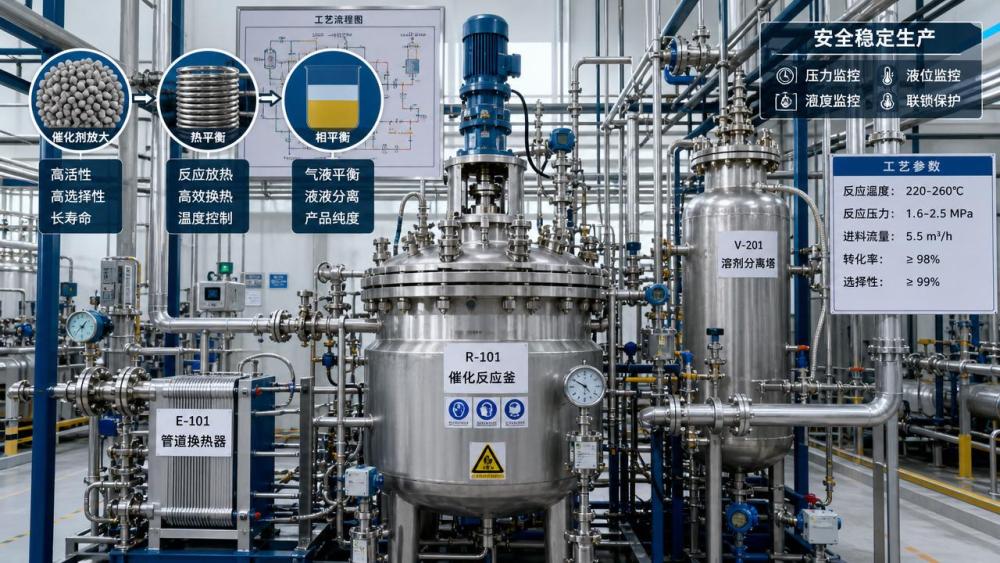
Chemical reaction thermodynamics describes whether a reaction can proceed, how far it can proceed, and how energy moves during conversion.
In catalyst scale-up, it answers three practical questions: Is the reaction favorable, where is equilibrium, and how much heat must be removed or supplied?
Catalysts change rate, not equilibrium position by themselves.
That distinction is essential because fast kinetics cannot overcome an unfavorable thermodynamic limit.
For example, exothermic oxidation or hydrogenation may look efficient in a reactor screen.
Yet scale-up can fail if adiabatic temperature rise deactivates the catalyst or pushes selectivity toward undesired byproducts.
In solvent-heavy systems, thermodynamic properties also influence solubility, phase behavior, and separation duty.
That directly affects recovery cost, emissions control, and equipment choice.
Why does chemical reaction thermodynamics matter beyond laboratory success?
Laboratory runs often hide scale-dependent energy effects.
Small reactors dissipate heat quickly, while industrial vessels accumulate heat unevenly.
Chemical reaction thermodynamics helps estimate these shifts before they become shutdown events.
It also supports realistic production economics.
A catalyst may show strong conversion, but poor thermodynamic efficiency can increase steam, cooling water, compression, or solvent recycling costs.
In highly regulated chemical sectors, this connects directly with eco-compliance.
Excess energy demand raises carbon intensity.
Poor equilibrium management can increase vent load, off-spec waste, and hazardous side product formation.
For BCIA-linked value chains, thermodynamic discipline supports cleaner synthesis and stronger supply chain resilience.
- More reliable heat removal plans
- Better prediction of equilibrium-limited yield
- Smarter solvent and pressure selection
- Lower rework and waste treatment burden
- Improved consistency across production campaigns
Which thermodynamic variables most influence catalyst scale-up decisions?
Several variables deserve early attention because they define the true operating envelope.
1. Enthalpy change
Reaction enthalpy estimates heat release or heat demand.
This is critical for reactor sizing, jacket design, emergency relief, and batch cycle planning.
2. Gibbs free energy and equilibrium constant
These values indicate spontaneity and maximum achievable conversion under defined conditions.
They help determine whether recycle loops or in situ removal steps are necessary.
3. Heat capacity and temperature dependence
Properties change with temperature, especially in multi-component mixtures.
Ignoring this can distort dynamic temperature predictions during startup and upset recovery.
4. Phase equilibrium
Gas-liquid and liquid-liquid equilibria affect mass transfer, catalyst wetting, and downstream separation.
This is especially important in hydrogenation, extraction, and solvent-switch processes.
5. Adsorption and desorption energetics
For heterogeneous systems, catalyst performance depends on how reactants and poisons bind to active sites.
Thermodynamic screening helps avoid severe selectivity loss at larger scale.
How can teams judge whether scale-up conditions are thermodynamically realistic?
A good approach combines reaction data, property models, and plant constraints from the beginning.
Chemical reaction thermodynamics should be reviewed before finalizing catalyst loading or reactor type.
Start with a simple checklist.
This review should happen before procurement, hazard review, and final process validation.
Late thermodynamic corrections are usually expensive.
What mistakes are common when applying chemical reaction thermodynamics?
One frequent error is assuming kinetic success proves scale-up readiness.
Fast lab conversion may still sit near a harsh equilibrium wall.
Another error is using pure-component data for complex industrial mixtures.
Impurities, stabilizers, water traces, and recycle streams often shift thermodynamic behavior significantly.
A third mistake involves underestimating solvent effects.
Solvents can alter activity coefficients, byproduct formation, and catalyst life.
Pressure misuse is another issue.
Higher pressure may favor equilibrium for gas reactions, but it can increase utility demand and mechanical complexity.
Finally, many projects ignore full energy integration.
Chemical reaction thermodynamics should inform not only the reactor, but also heat recovery and emissions treatment.
- Do not confuse reaction rate with thermodynamic favorability
- Do not scale heat transfer assumptions directly from bench data
- Do not ignore recycle composition drift
- Do not treat solvent choice as only a procurement decision
How does chemical reaction thermodynamics affect cost, compliance, and implementation time?
Better thermodynamic planning shortens development loops because fewer assumptions fail during pilot verification.
It also improves capital allocation.
Reactor metallurgy, heat exchange area, compression units, and recovery systems can be specified with greater confidence.
From a compliance perspective, chemical reaction thermodynamics supports safer operating envelopes and cleaner waste profiles.
That aligns well with low-carbon synthesis, halogen-free additive evolution, and eco-chemical process control.
In cost terms, the biggest gains usually come from energy efficiency, reduced off-spec material, and better raw material conversion.
For commodity-linked sectors, even small yield improvements can protect margins during feedstock volatility.
What is the most practical next step for stronger scale-up decisions?
Build chemical reaction thermodynamics into the earliest technical review, not the final troubleshooting stage.
Pair catalyst screening with energy balance, equilibrium modeling, and solvent property evaluation.
Then validate assumptions through pilot conditions that reflect actual recycle, impurity, and heat-load realities.
Across the BCIA landscape, this method supports better formula protection, greener execution, and more resilient production economics.
Chemical reaction thermodynamics is not a theoretical extra.
It is a decision framework for safe scale-up, predictable yield, and durable industrial competitiveness.
The strongest results come from treating thermodynamic insight as a core design input from the first experiment onward.
Recommended News