
Search
Category
Related Industries
- Vietnam Enacts Dual-List Rule for Pesticide TechnicalsVietnam Enacts Dual-List Rule for Pesticide Technicals: New mandatory prohibited ingredient list & full auxiliary disclosure effective May 1, 2026 — act now to avoid import suspension.
- China's National Carbon Market Exceeds $500M; Chemical Additives Sector Faces Inclusion DeadlineChemical additives sector faces urgent carbon compliance: China's national carbon market exceeds $500M as EU buyers demand PAS 2050/GHG Protocol footprint reports—act now to secure orders.
- New Coal Law Designates Coal as 'Strategic National Pillar'New Coal Law designates coal as 'strategic national pillar'—key implications for halogen-based flame retardant producers, importers & supply chain partners.
Weekly Insights
Stay ahead with our curated technology reports delivered every Monday.
Specialty Chemical Solvents for Clean Extraction




Specialty chemical solvents are central to clean extraction across modern industry. They improve selectivity, support safer handling, and help achieve stable purity targets in demanding production environments.
From pharmaceutical intermediates to coatings, electronics cleaning, and agrochemical formulation, specialty chemical solvents influence yield, residue levels, and downstream compliance. Solvent choice is no longer a simple materials decision.
It directly affects environmental performance, operating cost, product consistency, and supply resilience. In a market shaped by tighter regulations, clean extraction depends on informed solvent evaluation.
Definition and Functional Role of Specialty Chemical Solvents
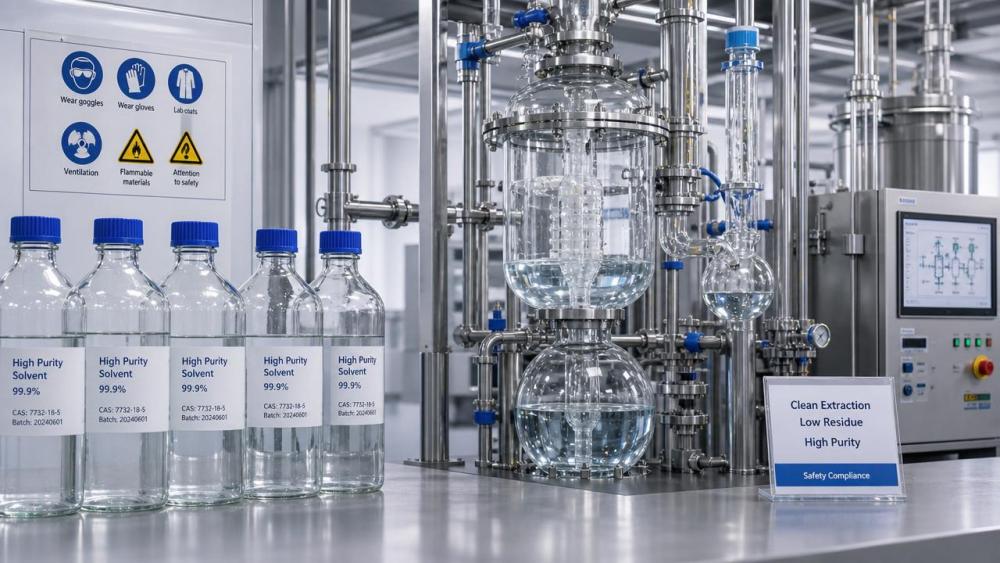
Specialty chemical solvents are engineered liquid media used to dissolve, disperse, carry, extract, or purify target substances under controlled process conditions.
Unlike commodity solvents selected only by price, specialty chemical solvents are often chosen for precise polarity, evaporation rate, solvency strength, and impurity control.
In clean extraction, their role is especially critical. They separate valuable compounds from complex matrices while minimizing degradation, contamination, and unnecessary co-extraction.
A suitable solvent system can shorten cycle time, reduce reprocessing, and simplify solvent recovery. An unsuitable one can raise waste loads and compromise final specification.
Core performance factors
- Solubility match with target compounds
- Low residue and controlled impurity profile
- Thermal and chemical stability during extraction
- Compatibility with equipment seals and metallurgy
- Recoverability, recyclability, and safe disposal pathway
Current Industry Context and Clean Extraction Priorities
The broader chemicals sector is moving toward stricter control of emissions, toxicity, worker exposure, and trace contaminants. This shift is redefining how specialty chemical solvents are sourced and applied.
Clean extraction now requires more than technical solvency. It also demands regulatory alignment, stable supply, and measurable environmental performance across the solvent lifecycle.
BCIA’s market perspective reflects this convergence of chemistry, compliance, and cost. Clean extraction succeeds when molecular performance is evaluated together with practical operating constraints.
Business Value of Specialty Chemical Solvents in Clean Extraction
The right specialty chemical solvents create value beyond laboratory efficiency. They influence throughput, waste treatment cost, product rejection risk, and environmental reporting burdens.
Key operational benefits
- Higher extraction selectivity and improved product purity
- Reduced by-product formation and lower cleanup demand
- More predictable drying, distillation, and solvent recovery
- Lower risk of corrosion, material incompatibility, or process upset
- Better alignment with safety and eco-compliance objectives
For integrated industrial systems, specialty chemical solvents can also support standardization. A well-validated solvent portfolio simplifies qualification, storage controls, and supplier management.
This matters in cross-border operations where one formulation may serve multiple production sites. Stable solvent standards reduce variability and support faster technical transfer.
Typical Application Scenarios Across the Comprehensive Industry
Specialty chemical solvents support clean extraction in many sectors connected to basic chemicals, additives, agrochemicals, and eco-chemical systems.
In each case, specialty chemical solvents are not isolated inputs. They interact with reaction design, equipment capability, waste management, and final market requirements.
Representative solvent families
- Polar aprotic solvents for high solvency extraction tasks
- Hydrocarbon solvents for selective dissolution and cleaning
- Oxygenated solvents for balanced evaporation and compatibility
- Tailored blends for process-specific cleanliness targets
Selection Criteria for Safer and Cleaner Solvent Systems
Choosing specialty chemical solvents for clean extraction should begin with process intent. The target compound, matrix complexity, and impurity tolerance define the technical window.
A practical review should then cover safety, regulatory status, and full-use economics. Purchase price alone rarely reflects true solvent performance.
Checklist for evaluation
- Confirm target solubility and unwanted co-extraction profile.
- Review boiling point, flash point, and drying behavior.
- Check residual solvent limits and impurity specifications.
- Assess recyclability and expected recovery efficiency.
- Verify compliance with destination market regulations.
- Evaluate supplier consistency and logistics resilience.
This structured approach helps compare specialty chemical solvents on a lifecycle basis. It supports cleaner extraction while reducing hidden losses from downtime, rework, or regulatory delays.
Implementation Notes and Process Control Considerations
Even strong solvent selection can fail without process discipline. Clean extraction depends on storage conditions, contamination prevention, equipment cleanliness, and monitoring during reuse cycles.
- Use sealed handling systems where moisture pickup affects performance.
- Track solvent aging, color, acid value, or non-volatile residue.
- Separate recovered streams by contamination class.
- Validate cleaning procedures between product campaigns.
- Document batch traceability for audits and investigations.
Specialty chemical solvents also benefit from periodic benchmarking. Small formulation or sourcing changes can alter extraction behavior, emissions profiles, or downstream compatibility.
Continuous review is especially important when moving toward lower-toxicity alternatives. Substitution should preserve extraction efficiency, not simply shift risk elsewhere in the process.
Next-Step Guidance for Solvent Strategy
A reliable specialty chemical solvents strategy starts with clear extraction priorities. Define purity goals, allowable residues, recovery expectations, and compliance boundaries before comparing options.
Then map solvent candidates against technical fit, total cost, and regulatory exposure. This creates a practical decision framework for cleaner, safer, and more resilient extraction systems.
BCIA’s intelligence-driven perspective is useful where solvent decisions connect chemistry with market reality. The most effective specialty chemical solvents are those that balance performance, eco-compliance, and durable supply economics.
For the next step, review current extraction lines, identify high-loss solvent points, and prioritize replacement or optimization based on purity risk and recovery potential.
Recommended News