
Search
Category
Related Industries
- How supply disruptions reshape chemical sourcing decisions worldwideGlobal chemical supply chain disruptions are reshaping sourcing. Explore smarter strategies for risk, compliance, dual sourcing, and resilient procurement.
- How to assess zero-carbon chemical synthesis catalysts for scale-upZero-carbon chemical synthesis catalysts: assess scale-up readiness through lifecycle emissions, durability, reactor fit, energy use, safety, and product quality.
- How to use a global chemical regulations guide for market entryUse a global chemical regulations guide to identify compliance triggers, reduce market-entry risks, and build a faster path to confident international chemical sales.
Weekly Insights
Stay ahead with our curated technology reports delivered every Monday.
What industrial chemical analysis reveals before scale-up




Before capital is committed and production lines are expanded, industrial chemical analysis reveals the hidden variables that determine whether scale-up will succeed or fail. For business decision-makers, it is the critical bridge between lab performance, regulatory compliance, cost control, and supply chain resilience—turning technical uncertainty into confident, commercially sound action.
Why industrial chemical analysis matters before scale-up
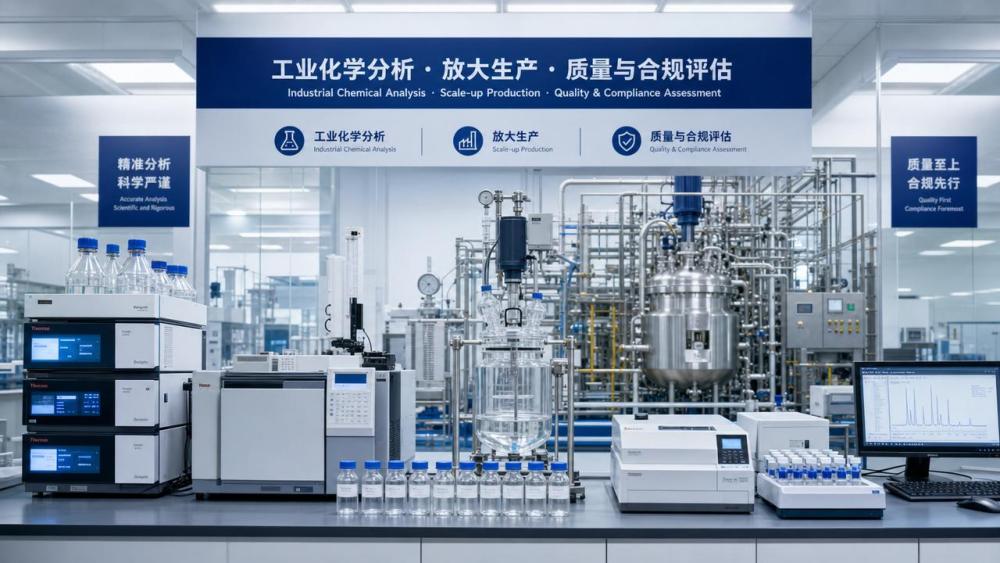
In fine chemicals, materials, agrochemical intermediates, solvents, and water-treatment formulations, scale-up failure rarely begins on the production floor. It usually starts earlier, when laboratory data is accepted without enough scrutiny of impurity behavior, thermal response, raw material variability, or downstream compliance exposure.
That is why industrial chemical analysis is not just a technical checkpoint. It is a board-level risk control tool. It helps decision-makers understand whether a promising formulation can survive larger batch sizes, real procurement conditions, stricter environmental limits, and the economics of continuous supply.
For organizations operating across basic inorganic and organic chemicals, specialty solvents, polymer auxiliaries, eco-friendly agrochemicals, and water eco-chemicals, the stakes are especially high. Minor shifts in pH, trace metals, moisture, viscosity, or solvent purity can change yield, shelf life, reaction selectivity, worker safety, and export eligibility.
- A solvent grade that performs in pilot trials may trigger inconsistent extraction performance at tonnage scale because trace water alters the reaction pathway.
- A polymer additive may meet the target physical property in one plant but fail aging or flame-retardancy stability due to supplier-to-supplier impurity drift.
- An agrochemical formulation may achieve efficacy, yet later face registration delays because analytical data packages do not align with expected residue or toxicological review standards.
BCIA approaches these questions from both molecule and market. Its cross-sector intelligence connects reaction thermodynamics, formulation barriers, compliance thresholds, and procurement timing so that scale-up decisions reflect commercial reality rather than isolated lab optimism.
What industrial chemical analysis actually reveals
When executives hear industrial chemical analysis, they often think of a certificate of analysis or a routine purity test. In practice, a strong analytical program reveals a much broader set of business-critical signals.
1. Process feasibility under scale conditions
Heat transfer, mass transfer, mixing efficiency, and residence time change dramatically during scale-up. Analytical review identifies whether the chemistry remains selective or begins to create side products that reduce yield and complicate purification.
2. Hidden impurity risks
Impurities are not only quality issues. They influence corrosion, catalyst poisoning, product color, odor profile, long-term storage, and compliance declarations. In basic chemicals and industrial auxiliaries, trace contaminants can materially change end-use acceptance.
3. Regulatory readiness
A formulation that scales technically may still fail commercially if analytical documentation cannot support REACH, EPA-related pathways, transport classification, wastewater discharge expectations, or buyer-specific restricted substance policies.
4. Procurement and supplier fit
Industrial chemical analysis helps distinguish between interchangeable and non-interchangeable raw materials. This matters when sourcing acids, alcohols, DMF, hydrocarbons, plasticizers, flame retardants, PAM flocculants, or fertilizer inputs from multiple regions.
5. Cost drivers beyond unit price
A lower-priced input may increase filtration load, solvent recovery cost, waste treatment burden, off-spec output, or batch rework frequency. Analysis clarifies total cost of ownership rather than invoice cost alone.
Which analytical checkpoints should decision-makers review?
The table below translates industrial chemical analysis into decision language. It shows which analytical checkpoints deserve management attention before approving scale-up investment.
For executives, the lesson is simple: do not approve scale-up based on “meets specification” alone. Ask whether the analytical package explains operating behavior, sourcing tolerance, compliance position, and waste-treatment impact under real production conditions.
How industrial chemical analysis changes decisions across BCIA’s five focus sectors
Different chemical categories fail for different reasons. A useful industrial chemical analysis program must reflect sector-specific decision pressure rather than use a generic checklist.
Basic inorganic and organic chemicals
In high-volume acids, bases, alcohols, and isocyanate-related supply chains, analysis often centers on concentration accuracy, corrosive behavior, trace metal contamination, moisture management, and storage compatibility. Small deviations can create major procurement and process losses at scale.
Industrial specialty solvents
For DMF, hydrocarbons, and other reaction media, analytical attention should focus on solvent purity, water content, non-volatile residue, recovery efficiency, and impurity carryover into final products. Solvent reuse economics often depend on these findings.
Rubber, plastic, and coating auxiliaries
Flame retardants, plasticizers, leveling agents, and stabilizers require more than active-content verification. Decision-makers should review dispersion behavior, thermal stability, migration tendency, compatibility with host polymers, and performance consistency after aging.
Eco-friendly agrochemicals
Here, industrial chemical analysis supports efficacy, formulation stability, impurity control, residue understanding, and registration readiness. A technically effective active ingredient may still struggle if analytical support for environmental or toxicological review is weak.
Water treatment and eco-chemicals
For PAM flocculants, antiscalants, and related treatment chemistries, analysis should connect molecular performance with real wastewater complexity. Charge density, molecular weight distribution, scaling control efficiency, and sludge burden all matter when operating costs are tight.
Lab success vs scale-up success: where many companies misjudge risk
The following comparison table highlights why industrial chemical analysis should be interpreted differently at laboratory scale and commercial scale.
This gap explains why many promising projects slow down after pilot approval. Industrial chemical analysis closes the gap by testing not only the chemistry, but also the practical tolerance of the business model behind the chemistry.
What procurement leaders should ask before approving a chemical scale-up
Chief procurement officers and operational decision-makers often inherit technical conclusions without seeing the analytical assumptions underneath them. A stronger approval process includes cross-functional questions.
- Can the formulation tolerate realistic feedstock variability from at least two qualified supply sources?
- Which impurities are process-critical, customer-critical, and compliance-critical? These are not always the same.
- What happens to yield, cycle time, and waste-treatment cost if purity drops within the allowable procurement range?
- Does the analytical package support buyer audits, export declarations, and expected registration pathways in target markets?
- Is there a workable substitution strategy if crude-linked solvent markets or regional regulations tighten unexpectedly?
This is where BCIA adds practical value. Its perspective does not stop at molecule-level interpretation. It connects compliance intelligence, reaction behavior, and commodity timing so leadership can compare options in commercial terms: risk, lead time, total cost, and supply continuity.
Compliance, standards, and export readiness cannot be an afterthought
Industrial chemical analysis becomes even more valuable when a company sells across regions. A formulation that is technically scalable but poorly documented can be delayed by customer qualification, customs review, or regulatory follow-up.
- For Europe-focused supply, decision-makers should examine whether analytical data can support substance identification, impurity discussion, and downstream compliance expectations associated with REACH-oriented workflows.
- For agrochemical and related environmental applications, data quality matters for registration logic, impurity discussion, residue-related review, and label-consistent claims.
- For specialty additives and solvents, buyer-driven restricted substance screening and application-specific declarations may affect market access even when no formal ban exists.
BCIA’s Strategic Intelligence Center is relevant here because compliance interpretation is not separated from chemistry. Regulatory thresholds, toxicological sensitivity, and buyer audit logic are assessed alongside formulation behavior and sourcing options, reducing the chance of expensive late-stage redesign.
Common misconceptions about industrial chemical analysis
“If the pilot batch passed, scale-up risk is low.”
Not necessarily. A pilot may still use cleaner inputs, shorter storage windows, and more attentive operating control than full production. Analytical robustness matters more than one successful run.
“A lower-cost raw material is acceptable if purity stays inside range.”
That assumption ignores impurity type, not just impurity level. Two raw materials with similar assay values may behave differently in reaction selectivity, odor, color stability, corrosion impact, or wastewater burden.
“Compliance can be handled after production stabilizes.”
Late compliance work often creates the most expensive delays. If a target market requests additional analytical explanation, reformulation or retesting after scale-up can erode margins and push back launch schedules.
FAQ: what decision-makers often ask
How early should industrial chemical analysis begin in a scale-up project?
It should begin before capital approval, not after pilot completion. The ideal point is when a formulation shows technical promise but before equipment sizing, supplier locking, and customer launch planning are finalized. That timing allows the analytical findings to influence design and sourcing rather than merely document them.
Which teams should review the analysis results?
At minimum: process, quality, procurement, EHS, regulatory, and commercial teams. Each function sees different risk in the same data. A moisture issue may look minor to a lab team but major to procurement if regional storage conditions amplify variability.
What are the biggest warning signs in industrial chemical analysis?
Watch for unstable impurity profiles, narrow operating windows, thermal sensitivity, poor compatibility with alternative suppliers, unresolved waste-treatment impacts, and incomplete compliance documentation. These often signal that scale-up economics are weaker than pilot data suggests.
Can analysis help with cost reduction, or is it mainly a safety and quality tool?
It helps with both. Industrial chemical analysis identifies where a lower-cost feedstock is truly interchangeable, where solvent recovery can improve, where additive dosage can be optimized, and where impurity control can reduce rework or waste load. The savings are often structural rather than short-term.
Why choose us for decision-grade chemical intelligence
BCIA is built for companies that need more than fragmented technical data. We connect the five major chemical pillars shaping modern manufacturing and agriculture: bulk basic chemicals, specialty solvents, polymer auxiliaries, eco-friendly agrochemicals, and water-treatment eco-chemicals.
That matters because industrial chemical analysis only becomes actionable when chemistry, compliance, and procurement are evaluated together. Our intelligence framework helps decision-makers examine formula barriers, thermodynamic constraints, eco-compliance exposure, and cross-border sourcing strategy in one decision flow.
- Need parameter confirmation? We can help clarify which purity, moisture, thermal, stability, and compatibility indicators should be treated as scale-up gates.
- Need product selection support? We can compare candidate raw materials or additive systems based on application fit, compliance burden, and total cost implications.
- Need delivery and sourcing insight? We can discuss how regional supply, crude-linked volatility, and alternative supplier qualification affect project timing.
- Need a customized route? We can structure discussions around formulation optimization, export-oriented compliance concerns, sample evaluation priorities, and quotation communication for realistic business planning.
If your team is evaluating whether a solvent system, additive package, agrochemical route, or water-treatment chemistry is truly ready for commercial expansion, contact us with your target application, current specifications, compliance destination, and expected production window. That gives us a practical basis to discuss analytical priorities, supplier fit, cost-sensitive options, and next-step feasibility.
Recommended News