
Search
Category
Related Industries
- Vietnam Enacts Dual-List Rule for Pesticide TechnicalsVietnam Enacts Dual-List Rule for Pesticide Technicals: New mandatory prohibited ingredient list & full auxiliary disclosure effective May 1, 2026 — act now to avoid import suspension.
- China's National Carbon Market Exceeds $500M; Chemical Additives Sector Faces Inclusion DeadlineChemical additives sector faces urgent carbon compliance: China's national carbon market exceeds $500M as EU buyers demand PAS 2050/GHG Protocol footprint reports—act now to secure orders.
- New Coal Law Designates Coal as 'Strategic National Pillar'New Coal Law designates coal as 'strategic national pillar'—key implications for halogen-based flame retardant producers, importers & supply chain partners.
Weekly Insights
Stay ahead with our curated technology reports delivered every Monday.
Absolute Eco-Compliance: Key REACH Risks in 2026




As 2026 approaches, absolute eco-compliance is becoming a decisive factor for chemical manufacturers, traders, and procurement leaders navigating REACH. From substance registration gaps to SVHC exposure and supply chain data blind spots, hidden compliance risks can quickly turn into export disruption, cost inflation, and reputational pressure. This article highlights the key REACH risks decision-makers must address now to protect market access and strengthen competitive resilience.
For companies active in basic chemicals, specialty solvents, polymer additives, agrochemical inputs, and water treatment chemistries, REACH is no longer a narrow regulatory function. It now affects sourcing strategy, formulation design, contract structure, inventory planning, and customer retention across the European market.
In boardrooms and procurement offices, the practical question is not whether compliance matters. The real question is where the next failure point may appear in a supply chain handling dozens, or even hundreds, of substances, blends, intermediates, and imported articles under tightening sustainability scrutiny.
Why REACH Risk Is Becoming a Strategic Issue in 2026
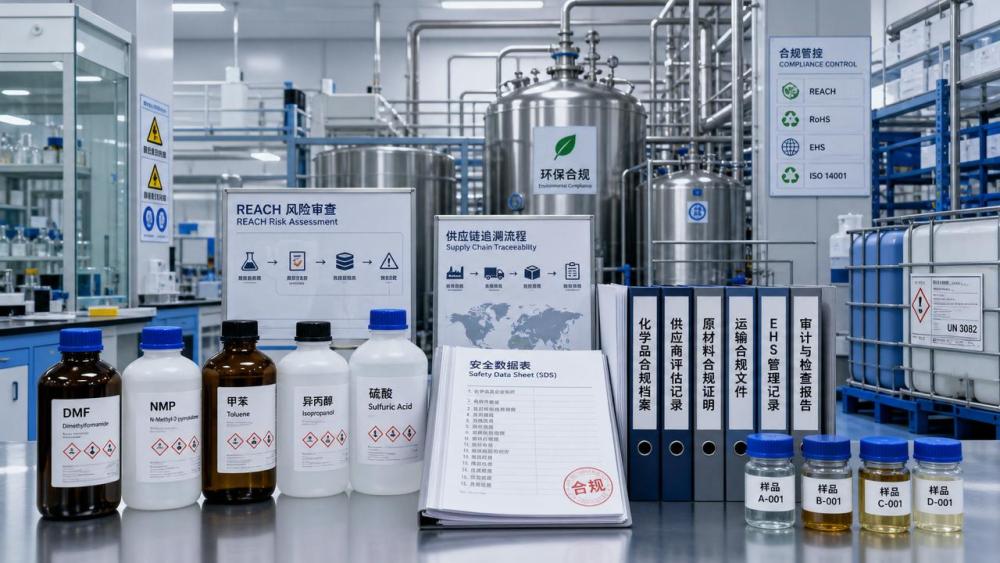
Absolute eco-compliance in 2026 means more than filing documents on time. It requires chemical businesses to align substance identity, hazard data, tonnage assumptions, use scenarios, customer communication, and supplier evidence across a lifecycle that often spans 12–36 months from sourcing to final downstream use.
Many executive teams still treat REACH as an isolated legal task. In practice, the strongest exposure often appears at the commercial level: delayed customs clearance, reformulation costs, unplanned testing budgets, loss of EU buyers, and contract penalties linked to non-conforming safety or disclosure records.
The pressure points for cross-border chemical trade
For BCIA-covered sectors, risk concentration is especially high where products move through multi-country tolling, repacking, or blended distribution models. A solvent imported at 100–1,000 tons per year presents different obligations from an additive sold in sub-mixtures, while article-related SVHC communication can trigger separate downstream issues.
- Registration status may not match actual annual tonnage bands.
- Supplier dossiers may not fully cover identified uses in coatings, polymers, or agrochemical processing.
- Updated classification or candidate list changes can disrupt customer approvals within 30–90 days.
- Only Representative arrangements may be incomplete or poorly documented.
Where leadership teams underestimate risk
The biggest blind spot is assuming a product is compliant because it has sold into Europe before. That assumption fails when supplier chains change, raw material purity drifts, impurities exceed threshold relevance, or an intended use expands from industrial processing to professional or consumer-facing applications.
A second blind spot is fragmented ownership. When procurement owns supplier onboarding, regulatory owns dossier checks, sales owns customer declarations, and operations own labels, a simple mismatch can remain hidden for 2–3 quarters before becoming a shipment hold or audit problem.
Typical business signals that a REACH review is overdue
- EU customers ask for updated SDS, exposure scenario alignment, or SVHC statements more than twice in one quarter.
- Annual purchase volumes rise by 15%–25%, moving a substance toward a new tonnage threshold.
- A formulation change introduces 1–3 new co-formulants without a full legal review.
- Imported mixtures rely on supplier declarations older than 24 months.
The table below maps the most common REACH risk categories against their likely commercial impact for decision-makers in chemicals and industrial auxiliaries.
The key takeaway is that absolute eco-compliance is now a margin-protection issue as much as a legal one. For high-volume acids, alcohols, amines, solvents, flame retardants, dispersants, fertilizer inputs, and water treatment chemicals, even one unsupported substance pathway can affect multiple customer contracts at once.
The Key REACH Risks Decision-Makers Must Address Now
A useful 2026 readiness model is to examine risk through five operational lenses: substance coverage, hazardous substance evolution, data integrity, supplier control, and commercialization discipline. Each one can create hidden cost if left unmanaged for more than one review cycle.
1. Registration and tonnage band mismatch
Tonnage is not static. A company importing 8 tons in one year can easily move to 12 or 15 tons after one large customer win. If the applicable registration coverage, role definition, or supplier representation is not reviewed at least every 6–12 months, the business may operate beyond its safe compliance boundary.
This is particularly relevant for basic organics, specialty solvents, and polymer auxiliaries where seasonal purchasing, contract manufacturing, and spot market substitutions distort annual volume visibility. Finance and procurement should not rely on purchase orders alone; they need a consolidated substance-level dashboard.
2. SVHC and restriction-related reformulation pressure
Substances of Very High Concern create strategic pressure well before a legal ban or restriction fully applies. In many sectors, OEMs, distributors, and private label customers begin asking for SVHC-free or lower-risk alternatives 12–24 months ahead of formal market deadlines.
For additives used in plastics, coatings, adhesives, and electronics cleaning, the real business risk is not only legal status. It is the speed at which customers shift specifications. A product can remain technically legal yet become commercially unviable if a buyer’s approved list changes next quarter.
High-attention categories for 2026 planning
- Plasticizers and flame retardant systems with elevated customer scrutiny.
- Solvents used in pharma, coatings, or electronics where purity and worker exposure expectations are rising.
- Agrochemical co-formulants facing tighter environmental profile review.
- Water treatment components with downstream municipal or industrial sustainability requirements.
3. Safety data and use-scenario inconsistency
An SDS may be technically available yet commercially weak if it does not match the customer’s actual use pattern. For example, a dispersant listed for industrial formulation may later be sold into a more specific application environment that changes ventilation assumptions, handling steps, or worker exposure conditions.
This mismatch tends to surface during customer qualification, supplier audits, or incidents. In practical terms, companies should verify at least 4 control points: substance identity, concentration range, classified hazards, and intended use description. If any one of these is outdated, the full communication chain becomes fragile.
4. Supplier evidence gaps and weak downstream communication
Absolute eco-compliance depends on evidence, not assumptions. A supplier statement without revision date, legal role clarification, and substance traceability often fails under buyer due diligence. This is common in multi-tier sourcing where traders, toll blenders, and repackers all touch the product before it reaches Europe.
Decision-makers should expect to review supporting records at least every 12 months, and faster for sensitive product families. A 3-step escalation path is useful: routine review, targeted legal check, and substitution or sourcing redesign if evidence remains incomplete after a defined remediation window.
How to Build an Absolute Eco-Compliance Response Framework
The most effective response is not a one-time audit. It is an operating model that turns regulatory change into structured decision-making. For chemical groups managing 20, 50, or 200 active SKUs, the goal is to shorten the time between signal detection and business action.
Create a five-layer review workflow
- Map every EU-linked substance, mixture, and article connection by legal entity and annual volume.
- Check registration, Only Representative, and import role coverage.
- Review SVHC, restriction relevance, and customer-specific negative lists.
- Validate SDS, labels, use scenarios, and technical data consistency.
- Assign actions with deadlines of 30, 60, or 90 days depending on risk severity.
This workflow matters most when companies operate across high-volume commodity chemistry and high-value functional additives at the same time. The risk profile of hydrochloric acid, DMF, MDI-based systems, chelated fertilizer inputs, and antiscalant packages may differ, but the governance discipline should be equally rigorous.
Set decision rules for procurement and sales
Procurement should not onboard a new source only on price, lead time, and quality. At minimum, four screening dimensions are needed: legal role clarity, document freshness, use coverage, and change notification capability. Sales teams, meanwhile, need rules on what claims can be made regarding eco-profile, restricted substance status, and customer declarations.
The following table helps leadership teams translate compliance controls into practical operating checkpoints.
The strongest pattern here is cross-functional ownership. When procurement, compliance, technical, and commercial teams share the same control calendar, absolute eco-compliance becomes measurable rather than reactive.
Build substitution readiness before the market forces it
In sectors such as plastic additives, solvents, and agrochemical formulation aids, the best time to evaluate alternatives is before customers demand immediate replacement. A practical pipeline includes 2–3 alternative chemistries, a basic performance comparison, exposure profile review, and a supply continuity check.
This approach reduces crisis spending. Instead of emergency reformulation under a 4-week deadline, businesses can plan lab screening, customer approval, and stock transition over 3–6 months. That difference directly affects margin, on-time delivery, and customer confidence.
What Enterprise Decision-Makers Should Do in the Next 90 Days
For leadership teams, the next 90 days should focus on exposure visibility rather than abstract policy drafting. The purpose is to identify which products, suppliers, and customer relationships would suffer first if REACH obligations or substance concerns tighten in 2026.
A practical executive checklist
- Rank top 20 EU-linked products by revenue, tonnage, and replacement difficulty.
- Flag any supplier declaration older than 12 months.
- Review the top 10 substances with the highest customer inquiry frequency.
- Identify product families exposed to likely reformulation or substitution pressure.
- Assign one owner for regulatory-commercial coordination at group level.
Three common mistakes to avoid
First, do not wait for a customer complaint to begin a dossier or supply-chain review. Second, do not assume that a compliant upstream supplier automatically covers your specific use and legal role. Third, do not separate compliance planning from purchasing strategy, because low-cost sourcing can become high-cost disruption very quickly.
For organizations working across basic chemicals, industrial auxiliaries, and eco-chemicals, absolute eco-compliance is best treated as a strategic filter for product portfolio durability. Companies that can document substance control, accelerate substitution decisions, and maintain stronger supply evidence will be better positioned to protect EU access in 2026 and beyond.
BCIA supports enterprise decision-makers with market intelligence across inorganic and organic feedstocks, specialty solvents, polymer additives, agrochemical inputs, and water treatment chemistries where regulatory pressure and sourcing economics increasingly overlap. If you need a clearer view of REACH exposure, substitution priorities, or supplier risk structure, now is the time to act.
Contact us to discuss your product portfolio, request a tailored compliance intelligence framework, or explore practical solutions for strengthening absolute eco-compliance without losing cost competitiveness.
Recommended News