
Search
Category
Related Industries
- BASF Starts Up $1 Billion MDI Plant, Doubling Annual Capacity to 600,000 TonnesBASF's $1 billion Geismar MDI plant reportedly doubles annual capacity to 600,000 tonnes. Explore the potential impact on North American supply and sourcing.
- How sustainability trends are reshaping chemical supply chainsExplore chemical industry trends sustainability leaders need to know, from lower-carbon sourcing to circularity, safer chemistry, and supply chain resilience.
- 40th China Plant Protection Fair Opens in Chengdu With Standards and RNA Pesticide FocusChina Plant Protection Fair in Chengdu highlights 10 group standards and RNA pesticide technology. Explore what buyers and suppliers need to verify.
Weekly Insights
Stay ahead with our curated technology reports delivered every Monday.
Used PVC Calender Lines: What to Check in Equipment Records




A used PVC calender line can appear complete in a sales photograph while its records reveal a more complicated purchase: unmatched rolls, an incomplete drive upgrade, missing heating-zone diagrams, or no evidence of the last production run. Before comparing prices, buyers need to establish which machines are included, how they were operated and maintained, and what evidence supports their claimed condition.
Equipment records cannot replace a physical inspection or a production trial. They do, however, help define what to inspect, identify gaps that affect the purchase price, and prevent a buyer from treating an undocumented line as a ready-to-run production asset. The most useful review connects each document to a specific machine, component, date and operating condition.
Establish the identity and boundaries of the line
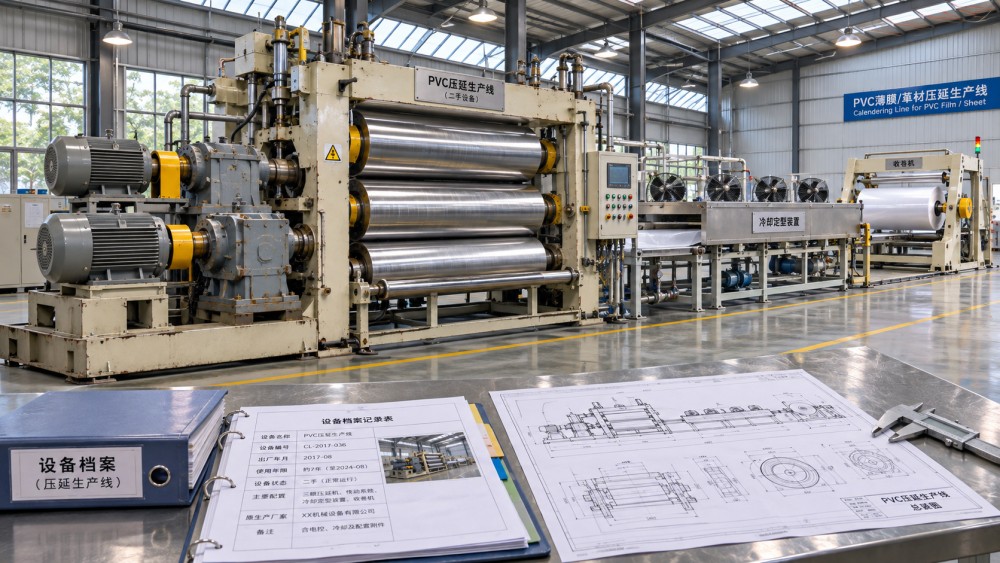
A PVC film or sheet calender line is a collection of interconnected equipment, not just the calender itself. Depending on the process, the offered package may include material preparation equipment, a mixer, an extruder or other feed equipment, the calender, temperature-control units, cooling and take-off sections, thickness measurement, trimming, winding and electrical controls. The exact configuration matters because a missing auxiliary can change the installation budget and the time needed to reach production.
Request an equipment schedule that identifies the manufacturer, model, serial number, year where available, and location of each major unit. Compare that schedule with nameplates, photographs, electrical cabinets and layout drawings. A line assembled or modified over time may have components of different ages; a single year in a listing should not be assumed to describe every part.
Descriptions that allow buyers to view used machinery details can provide a starting point for identifying the advertised configuration. The record review should then establish whether the listed equipment is physically present, included in the sale and suitable for the intended process. A photograph of an auxiliary next to the line does not, by itself, establish ownership or inclusion.
Ask for a clear division between equipment included, equipment excluded and items whose status remains unconfirmed. Pay particular attention to spare rolls, tooling, control panels, transformers, cooling units, extraction equipment and lifting fixtures. An inventory signed before dismantling is more useful than a general statement that the line is sold “complete.”
Connect the operating history to the intended product
Past production records provide context for the wear and capability of a line. Ask what products it made, whether it processed rigid or flexible PVC, the approximate operating periods, and when it was last run. Product specifications, operating logs and previous setup sheets can help explain why the machine was configured in a particular way.
For a buyer planning thin film, records concerning gauge control, roll condition and winding are likely to be especially relevant. A buyer making thicker sheet may place different weight on feed capacity, roll loading, cooling and downstream handling. In either case, a previous product range is evidence of what was attempted or produced under specific conditions; it is not a guarantee that a different formulation or finish will run at the same rate.
Review stated output alongside material formulation, product width and thickness, line speed, yield and operating time. A production figure without those conditions may not be comparable with the buyer’s requirement. If records distinguish startup scrap from stable production, they can also help estimate the practical effort involved in changing products. Where commercially sensitive formulations are withheld, the seller may still be able to share operating ranges or anonymized production sheets.
Long idle periods deserve their own questions. Indoor storage, preserved openings and periodic maintenance may leave a different risk profile from exposure to moisture or dismantling without preservation. Request shutdown and storage records, including dates, protective measures and any work performed before a proposed restart.
Read maintenance history as evidence, not a service label
“Regularly maintained” is difficult to evaluate without work orders, inspection reports or replacement-part records. Look for a chronological history that distinguishes routine work from failures and major repairs. An isolated repair is not automatically a reason to reject a line; its significance depends on the cause, the quality of the repair and what happened afterward.
- Recurring faults: Repeated bearing, gearbox, drive or heating-zone problems may indicate an unresolved cause. Compare repair dates with downtime and subsequent operating records.
- Major overhauls: Identify who performed the work, which components were replaced or reconditioned, and whether inspection measurements or commissioning reports are available.
- Parts substitution: Check whether replacement motors, drives, sensors and controllers match the installed configuration and whether their documentation is included.
- Open defects: Request the seller’s outstanding maintenance list and distinguish known defects from items that simply have not been tested.
Gaps in a maintenance file do not prove that maintenance was neglected. They do reduce confidence in the history and may require more inspection or a larger contingency. A buyer should record missing evidence explicitly rather than silently assuming that an unrecorded task was completed.
Examine roll, drive and temperature-control records
The calender rolls and their associated adjustment systems have a direct bearing on the surface and thickness of the finished material. Request roll drawings, identification numbers, regrinding or resurfacing records, and available dimensional inspection reports. Compare measurements with the manufacturer’s tolerances where those tolerances are available and applicable. A report should identify the roll, measurement method and date; a measurement with no traceable component is hard to use in an acceptance decision.
Ask whether roll surfaces have corrosion, scoring, coating damage or evidence of prior repair, and whether the current roll geometry is appropriate for the intended application. Check records for bearings, lubrication and roll-gap adjustment mechanisms as well. A polished surface alone does not establish bearing condition, alignment or the behavior of the roll under operating load.
For the drive train, review motor and gearbox identification, lubrication history, repair reports and any available vibration or condition-monitoring results. Compare the installed drive arrangement with current electrical drawings. If a gearbox or drive has been replaced, confirm that the documentation describes the equipment actually present, including any changes to couplings or control settings.
Temperature-control records should cover the calender rolls and other relevant heating or cooling zones. Ask for piping diagrams, heater and sensor lists, controller settings, calibration records where available, and the history of leaks or blocked circuits. A temperature display may show a value without proving that the sensor is correctly located or that heat is being distributed as intended. Those questions need inspection and, where feasible, a controlled operating test.
Verify controls, safety documentation and local requirements
Obsolete or undocumented controls can turn a mechanical purchase into a substantial integration project. Request the latest electrical schematics, panel layouts, programmable controller documentation, software backups and a list of installed drives and sensors. Confirm whether passwords, programming tools and software licences can be transferred or otherwise made available to the buyer; the presence of a backup file does not establish that the buyer can use it.
Compare the diagrams with the actual cabinets. Handwritten revisions, disconnected wires and undocumented bypasses are reasons to expand the inspection. Ask who will identify cables before dismantling and whether labelled photographs and termination records will accompany the shipment. Reconnection becomes more uncertain when the only accurate knowledge remains with the previous operator.
Safety documents should describe the machine as currently configured, including guarding, emergency stops, interlocks and any changes made during its working life. A past certificate or declaration may be useful evidence, but it does not by itself establish that the relocated line meets the requirements applicable at the new site. Requirements depend on the destination, intended use, modifications and the responsibilities of the parties. The buyer should have a qualified local specialist assess the applicable obligations and the work needed before operation.
For example, U.S. buyers can use OSHA’s machine guarding requirements in 29 CFR 1910.212 and control-of-hazardous-energy requirements in 29 CFR 1910.147 as starting points for a site-specific review. These are U.S. requirements, not a substitute for determining the rules that apply elsewhere. Source: U.S. Occupational Safety and Health Administration, standards 29 CFR 1910.212 and 29 CFR 1910.147.
Match documentary claims to an inspection and trial plan
A desk review is most effective when it produces a short list of claims to verify. If records say a roll was reground, identify it during inspection and compare the report with the installed roll. If a drive was upgraded, confirm its model and observe any alarms or abnormal behavior during operation. If a component cannot be inspected because the line has already been dismantled, record that limitation and decide how it affects the offer.
Where the seller can safely run the line, agree on the trial conditions in writing: material, product dimensions, operating period, measurement method, personnel responsibilities and acceptance criteria. Record relevant temperatures, speeds, thickness measurements, visual defects and stoppages under those conditions. A trial with the buyer’s intended material can be more informative than a demonstration with an unrelated formulation, although material availability and confidentiality may limit what is practical.
A no-load demonstration can help check basic movement and control functions, but it does not demonstrate finished-product quality or stable performance under production load. If a running trial is unavailable, consider additional independent inspection, review of recent production evidence, or contract terms that reflect the unverified condition. A recently recorded run is useful only when the line and its configuration can be matched to the equipment being sold.
Turn record gaps into purchase and delivery terms
Before approval, assemble a risk register with four fields: the claim or requirement, the evidence available, the unresolved question and the person responsible for closing it. This keeps procurement, maintenance, engineering and production teams focused on the same assumptions. It also separates a minor missing manual from an issue that could prevent installation or acceptance.
The commercial comparison should include more than the asking price. Depending on the line and destination, allowances may be needed for dismantling, packing, transport, foundations, utilities, electrical adaptation, guarding, spare parts, reassembly and commissioning. Obtain quotations or engineering estimates where possible; when the scope is not yet known, identify the amount as a contingency rather than presenting it as a firm cost.
The purchase agreement should define the equipment inventory, condition disclosures, documents and software to be delivered, inspection rights, dismantling responsibilities and the point at which risk transfers between parties. Where performance is a condition of purchase, specify a realistic test and the remedy if the agreed criteria are not met. Legal and technical review may be needed to make those provisions workable in the relevant jurisdictions.
The strongest purchase decision is not necessarily the line with the thickest file. It is the line whose known condition, missing evidence and remaining work can be reconciled with the buyer’s product requirements, installation capability and tolerance for uncertainty.
Recommended News