
Search
Category
Related Industries
- China Soda Ash Producer Inventories Fall to 1.3689 Million Tonnes in Week to October 26China soda ash producer inventories fell 6.94% to 1.3689 million tonnes in the week to October 26. Explore what the drawdown means for procurement planning and supplier delivery checks.
- What determines the cost of professional REACH compliance guidance?REACH compliance guidance cost depends on substance complexity, tonnage, data gaps, and support scope. Discover hidden expenses and compare quotes to build a smarter compliance budget.
- China TDI Price Reaches RMB 40,833 per Tonne on October 25, Up 9.38% in 10 DaysChina TDI price reached RMB 40,833 per tonne on October 25, 2026, up 9.38% in 10 days. Explore market trends and procurement cost implications to inform your purchasing decisions.
Weekly Insights
Stay ahead with our curated technology reports delivered every Monday.
BCIA Basic Organic Chemicals Sourcing Guide: What Should Buyers Check?




A reliable BCIA basic organic chemicals sourcing guide helps buyers move beyond a quoted price and assess what truly protects production continuity: supplier capability, material purity, regulatory compliance, logistics resilience, and exposure to cost volatility. Whether the requirement is for alcohols, organic acids, ketones, esters, hydrocarbons, glycols, or key intermediates, the real procurement question is rarely “Who is cheapest today?” It is “Which supply option will still work when specifications tighten, freight shifts, or demand suddenly changes?”
Basic organic chemicals sit quietly underneath a remarkable range of products: coatings, resins, pharmaceuticals, detergents, inks, adhesives, crop inputs, plastic compounds, electronic cleaning formulations, and water-treatment systems. Their apparent simplicity can mislead buyers. A solvent may look interchangeable on paper, yet a small difference in water content, acidity, inhibitor level, trace metals, or packaging condition can affect reaction yield, color stability, drying time, odor, or downstream compliance.
For procurement teams, technical managers, and importers, a sound sourcing decision therefore begins with a broader view of risk. The following checks are designed to turn that view into a practical buying framework.
Start with the material’s job, not its trade name
Before comparing suppliers, define what the chemical must do in the process. “Acetic acid,” “isopropyl alcohol,” or “ethyl acetate” is not yet a complete sourcing specification. The same chemical may be supplied in grades intended for industrial processing, coatings, electronics, pharmaceuticals, food-related applications, or other controlled uses. A suitable grade depends on the actual performance window, not merely the CAS number.
Ask production and quality teams a few direct questions:
- Is the material a reaction feedstock, extraction medium, cleaning solvent, diluent, pH adjuster, or formulation component?
- Which impurities create the greatest risk: water, chlorides, aldehydes, non-volatile residue, metals, color, sulfur compounds, or unknown organics?
- Is consistency from batch to batch more important than achieving the tightest possible purity?
- Could a change in source affect customer approvals, product registration, safety documentation, or finished-product labeling?
- Does the process require a specific inhibitor, denaturant status, vapor-pressure range, or flash point?
This step prevents one of the most expensive sourcing mistakes: buying a technically compliant-looking material that performs differently in real production. A low moisture figure, for example, may be essential for moisture-sensitive polymerization, while a coating manufacturer may be more concerned with evaporation behavior and residue after drying. The correct specification should describe the application’s critical control points, not simply copy a generic supplier datasheet.
Build a specification that can be audited
A purchase order should not be the first place where material expectations become precise. Create an agreed technical specification before commercial negotiations are finalized. It should state the product name, CAS number where relevant, grade, assay method, permitted impurity limits, appearance requirements, packaging format, shelf-life expectations, and sampling or rejection process.
For bulk organic chemicals, it is also wise to distinguish between typical values and guaranteed limits. A certificate of analysis may show excellent typical results, but only a defined contractual limit gives the buyer a meaningful basis for acceptance or claim management. If color, acidity, water, or distillation range matters to your process, specify the test method as well as the limit. Different analytical methods can produce results that are not directly comparable.
Request a recent certificate of analysis, safety data sheet, and technical data sheet during qualification. For critical materials, ask for representative batch history rather than a single favorable COA. A pattern of results says more about manufacturing control than one document selected for a sales discussion.
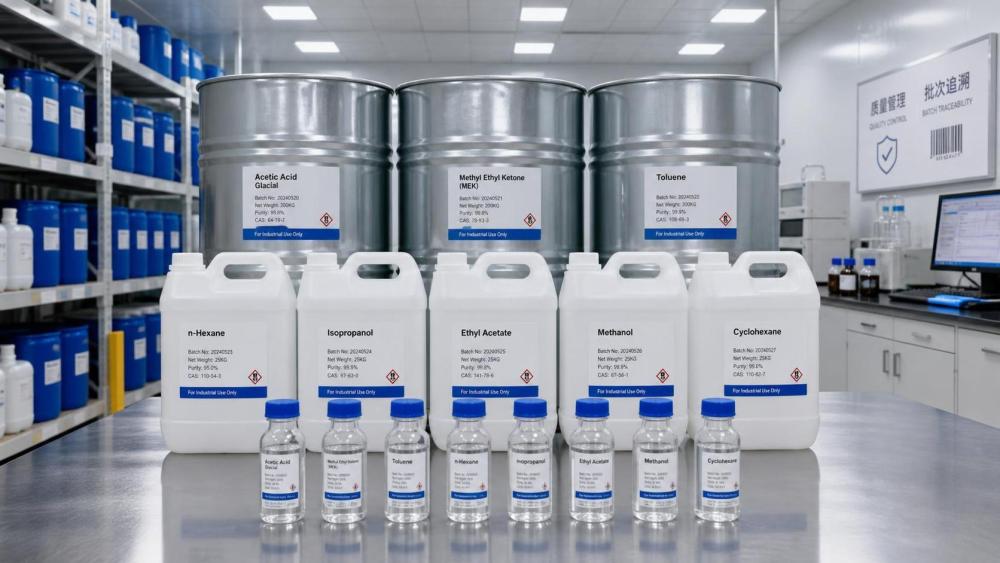
Look behind the supplier: producer, distributor, or trader?
The supply chain role of a vendor affects price, flexibility, technical support, and risk. None of the following models is automatically superior, but buyers should know which one they are dealing with.
For a strategic solvent or intermediate, it is reasonable to ask where the material is manufactured, whether the seller controls inventory, and whether the offered product comes from a recurring source or an opportunistic lot. A trader can be a valuable route to market, especially when regional availability matters, but transparency is essential. Buyers need to know whether they are qualifying a stable supply channel or a one-time transaction.
BCIA’s intelligence perspective is particularly useful here: a chemical is not only a molecule; it is also a chain of feedstocks, plants, storage terminals, regulations, shipping lanes, and contractual relationships. Understanding that chain makes sourcing decisions less dependent on assumptions.
Check quality control where failures actually occur
Quality risk does not begin and end at the factory gate. Basic organic chemicals can be affected by tank cleaning, cross-contamination, drum reuse, moisture ingress, incorrect labeling, temperature exposure, and long storage periods. This is especially relevant for hygroscopic materials, volatile solvents, oxidation-sensitive products, and materials transported in bulk tanks.
For first-time or high-volume purchases, establish a practical quality-control plan. This may include pre-shipment sampling, independent inspection, retention samples, sealed sample protocols, and incoming testing at the buyer’s site. The level of control should match the consequence of failure. A small-volume cleaning solvent may only need document review and routine receipt inspection; a process-critical monomer or high-purity extraction solvent may justify a more rigorous release procedure.
Do not overlook packaging. Confirm whether the product will arrive in new steel drums, HDPE drums, IBCs, isotanks, flexitanks, or bulk tankers; then check compatibility with the chemical and the receiving site. Packaging specifications should cover net weight tolerances, closures, UN markings when applicable, palletization, liner requirements, and tamper evidence. A chemically correct product can still become unusable if delivered in a container that does not suit local handling equipment or storage rules.
Compliance is not a document request—it is a market-access question
Organic chemicals move through a dense regulatory environment. Depending on the destination and application, buyers may need to consider REACH obligations in Europe, TSCA status in the United States, GHS classification, transport classifications, controlled-substance rules, VOC restrictions, food-contact requirements, pesticide or biocide registration implications, and local import licensing.
The key is to assign responsibilities clearly. Who provides the compliant safety data sheet for the destination market? Who confirms substance inventory status? Who bears responsibility if the composition changes? Who monitors new restrictions or hazard classification updates? These questions become even more important when a chemical is used in a downstream formulation rather than sold as a standalone commodity.
Buyers should request current regulatory statements appropriate to their intended use, but they should also avoid treating a supplier declaration as a substitute for internal review. A solvent may be lawful to import yet unsuitable for a customer’s restricted-substance policy. An additive may meet a broad regulatory requirement but introduce labeling, worker-exposure, or waste-disposal burdens that the plant is not prepared to manage.
BCIA tracks the intersection of formula performance and compliance pressure because the two are increasingly inseparable. The most practical sourcing choice is often not the material with the lowest invoice price, but the one that allows a finished product to keep moving through customer audits, export controls, and environmental expectations.
Stress-test logistics before signing a long-term supply agreement
Supply continuity depends on more than nominal plant capacity. Ask how product reaches your facility: by road tanker, rail, sea freight, ISO tank, containerized drums, or local warehouse release. Each route carries different risks related to lead time, cleaning standards, port congestion, dangerous-goods handling, temperature management, and return logistics.
For imported bulk chemicals, clarify Incoterms, named delivery point, insurance responsibility, customs-document ownership, and demurrage exposure. For hazardous goods, confirm that carriers and storage partners are authorized for the relevant classification. If a product is prone to freezing, polymerization, pressure buildup, or degradation under heat, the logistics plan must address those conditions rather than assume ordinary freight treatment is adequate.
Dual sourcing is often discussed as a simple safeguard, but it only works when the second source has been technically qualified. Maintaining a nominal backup supplier that has never passed production trials can create false confidence. Where dual sourcing is impractical, alternatives include safety stock, regional inventory, flexible packaging options, agreed allocation language, or a supplier-held buffer stock arrangement.
Read the price through its feedstock and energy exposure
Basic organic chemicals are linked to wider industrial economics. Methanol, ethylene, propylene, benzene, natural gas, crude oil, coal-based routes, electricity costs, and regional operating rates can all shape availability and pricing. A quote should therefore be evaluated as a pricing mechanism, not just a number.
Ask whether the offer is fixed, indexed, formula-based, or subject to periodic review. If it is indexed, understand the index, timing, currency, freight component, and adjustment frequency. If it is fixed, identify what happens during exceptional market disruption. A price that looks attractive today may carry hidden exposure if freight, currency, or feedstock changes are passed through without defined rules.
Long-term contracts work best when they balance predictability with realism. Useful provisions can include volume bands, forecast-sharing expectations, quality-change notification periods, audit rights, force majeure definitions, dispute resolution steps, and a clear process for handling off-spec material. Procurement should involve finance, operations, quality, and legal teams early; chemical sourcing is too interconnected to be managed as a purchasing-only exercise.
A practical BCIA basic organic chemicals sourcing checklist
Before approving a new supplier or renewing a major contract, use this final review:
- Material fit: Is the grade aligned with process needs and critical impurity limits?
- Evidence: Have current COAs, SDSs, specifications, and relevant regulatory statements been reviewed?
- Traceability: Can the supplier identify producer, batch, origin, storage location, and shipment history?
- Control: Are sampling, testing, claims, and change-notification procedures agreed in writing?
- Compliance: Has the intended market and downstream use been checked, not merely the import transaction?
- Logistics: Are packaging, transport mode, storage conditions, and emergency arrangements suitable?
- Resilience: Is there a qualified alternative, buffer plan, or credible allocation strategy?
- Commercial clarity: Are pricing drivers, Incoterms, currency exposure, and liability boundaries understood?
The value of a sourcing guide is not in adding paperwork. It is in helping buyers see the points where a seemingly ordinary organic chemical can become a production interruption, compliance issue, or costly quality deviation. With a disciplined qualification process, procurement teams can compare suppliers on the factors that matter after the first shipment—not only on the price shown in the first quotation.
BCIA supports this wider decision-making lens by connecting basic chemicals intelligence with solvent performance, industrial additives, environmental requirements, and global supply-chain conditions. In a market shaped by both molecular precision and operational uncertainty, informed sourcing is one of the most practical forms of risk control.
Recommended News