
Search
Category
Related Industries
- China Soda Ash Producer Inventories Fall to 1.3689 Million Tonnes in Week to October 26China soda ash producer inventories fell 6.94% to 1.3689 million tonnes in the week to October 26. Explore what the drawdown means for procurement planning and supplier delivery checks.
- What determines the cost of professional REACH compliance guidance?REACH compliance guidance cost depends on substance complexity, tonnage, data gaps, and support scope. Discover hidden expenses and compare quotes to build a smarter compliance budget.
- China TDI Price Reaches RMB 40,833 per Tonne on October 25, Up 9.38% in 10 DaysChina TDI price reached RMB 40,833 per tonne on October 25, 2026, up 9.38% in 10 days. Explore market trends and procurement cost implications to inform your purchasing decisions.
Weekly Insights
Stay ahead with our curated technology reports delivered every Monday.
How Should Buyers Compare Basic Organic Chemical Suppliers with BCIA?




Price is a necessary comparison point when sourcing basic organic chemicals, but it is rarely the decision that protects a business. A lower offer can become the most expensive option if the material arrives with inconsistent purity, incomplete traceability, unsuitable packaging, or documentation that cannot support downstream sales.
This is especially true for pesticide technical materials, intermediates, solvents, and functional additives. Their value is not defined only by a specification sheet. It depends on whether the supplier can repeatedly deliver a material that performs as expected in formulation, remains acceptable in the destination market, and reaches the site without disrupting production. BCIA organic pesticides supplier reliability intelligence is useful because it connects these separate questions: chemistry, compliance, logistics, and commercial exposure.
Start with the material's job, not the supplier's catalogue
“Basic organic chemicals” covers a broad range of materials. Alcohols, ketones, aromatic compounds, organic acids, amines, intermediates, solvents, pesticide technicals, and formulation auxiliaries may all sit in the same sourcing category, but they should not be evaluated in the same way.
A solvent used for cleaning equipment may allow some flexibility if it does not enter the finished product. A solvent used in a pharmaceutical, coating, electronic, or pesticide formulation may require closer control of water content, residual impurities, odor, color, and batch consistency. A pesticide active ingredient needs an even more careful review because its impurity profile, physical form, stability, and documentation can affect formulation behavior, product registration, handling, transport, and field-use expectations.
Before contacting suppliers, define the intended use in operational terms:
- What function does the material perform in the process or finished formulation?
- Which characteristics can affect output quality: assay, moisture, acidity, particle size, color, residue, or storage stability?
- Is the material sold into a regulated market or used only internally?
- What happens if a shipment is delayed, a batch varies, or a document is missing?
- Can production switch suppliers without reformulation, revalidation, or customer approval?
These answers determine how demanding the supplier qualification process needs to be. Procurement teams often lose time comparing suppliers before they have agreed on which failures would actually stop production or create downstream risk.
Compare reliability as a chain of evidence
A supplier’s reliability is not proved by a polished website, a broad product list, or an attractive quotation. It is better assessed as a chain of evidence. Each link should support the next: identity of the material, technical capability, quality control, legal suitability, delivery capability, and response when something goes wrong.
The same evidence should be requested from every shortlisted supplier. Otherwise, procurement may compare a detailed technical response from one company with a simple price quote from another and mistake missing information for simplicity.
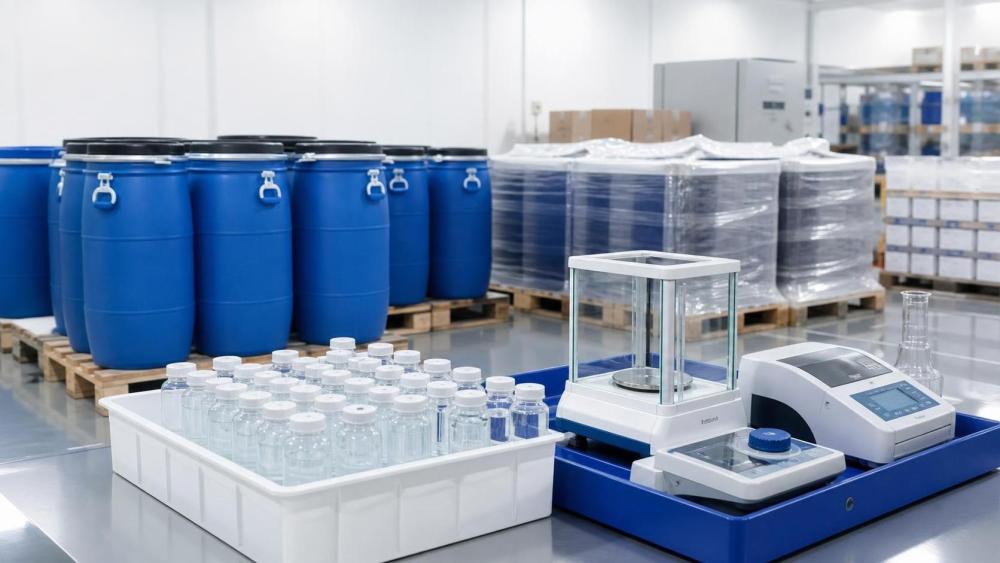
For organic pesticides, formulation risk must be part of supplier selection
Organic pesticide sourcing requires a more focused approach than buying a commodity solvent or general intermediate. The active ingredient may be technically acceptable on paper yet behave differently once it is milled, dispersed, emulsified, diluted, or stored in the final formulation.
Particle morphology can influence dispersion. Moisture can affect flowability or degradation. Minor impurities may alter odor, color, pH behavior, compatibility with surfactants, or storage stability. The practical concern is not whether every impurity is inherently unacceptable; it is whether the supplier can identify the critical variables for the intended formulation and control them consistently.
For this reason, a buyer should avoid treating a sample as final proof of supplier performance. A lab sample is useful for initial screening, but a meaningful qualification normally asks whether production-scale batches are made under the same controls, packed in the same way, and shipped under conditions that preserve the material. When the material will support a registered or tightly specified agrochemical product, uncontrolled substitutions in manufacturing route, source, impurity profile, or packaging can create a serious downstream problem.
Questions that produce useful answers include:
- Which specification attributes are controlled for every batch, and which are reported only on request?
- How are out-of-specification batches isolated and investigated?
- Will the supplier notify the buyer before a material-source, process, packaging, or specification change?
- What storage conditions preserve the material’s intended properties during realistic transit and warehouse periods?
- Can technical staff discuss compatibility with the planned formulation system rather than only provide a generic data sheet?
A supplier that cannot answer these questions may still be appropriate for low-risk, noncritical consumption. It is a weaker fit for a material that controls pesticide performance, regulatory documentation, or a branded formulation’s consistency.
Do not separate compliance from procurement
Basic organic chemicals move across several regulatory and operational boundaries. A chemical can be available for purchase but still be unsuitable for the buyer’s planned destination, application, transport mode, or customer requirements. In agrochemicals, the distinction between a technical material, a formulation component, and a market-ready product matters greatly.
Compliance review should therefore begin before commercial commitment. The practical goal is to establish whether the supplier can provide a documentation trail that supports internal safety review, import planning, customer questionnaires, and product stewardship. This may include safety data, transport information, composition-related declarations where needed, labeling support, and records that connect a shipment to its batch documentation.
For buyers serving more than one geography, it is also important to distinguish between a supplier that can provide a document and one that understands why the document is needed. The latter is better positioned to flag conflicts early, such as a packaging choice that complicates transport, an impurity concern affecting a downstream customer, or a change that needs review before future shipments.
BCIA’s intelligence scope is relevant here because it spans basic organic and inorganic materials, specialty solvents, polymer auxiliaries, eco-friendly agrochemicals, and water-treatment chemistry. These categories often intersect in real procurement. A pesticide formulator may need an active ingredient, a solvent or carrier, dispersants, stabilizers, packaging-compatible additives, and treatment chemicals for process water. Assessing them in isolation can leave blind spots in the final supply plan.
Calculate total sourcing risk, not unit price
The quoted price per kilogram or tonne is visible. The costs created by a poor supplier choice are usually dispersed across quality, operations, logistics, and compliance teams. They include trial batches that fail, rework, delayed customer deliveries, emergency freight, excess inventory held as protection, and time spent resolving inconsistent documents.
A higher-priced supplier may be commercially stronger when it offers predictable lot quality, responsive technical communication, stable packaging, and disciplined change control. That does not mean the highest price is safer. It means price should be evaluated after the buyer has established that the compared offers are genuinely equivalent.
A useful internal comparison is to place suppliers into three groups:
- Approved production sources: suitable for critical materials after technical and commercial qualification.
- Development sources: promising suppliers that need further samples, documentation, or pilot-scale evidence.
- Contingency sources: alternatives maintained for resilience, but not yet ready for unrestricted production use.
This approach is more practical than relying on one “best” supplier. For high-volume organic chemicals, resilience may require a qualified second source. For highly specialized or registration-sensitive materials, the better decision may be to concentrate volume with one controlled source while maintaining early visibility of alternatives.
Where BCIA can improve the comparison process
BCIA should be used as an intelligence layer, not as a substitute for the buyer’s own technical qualification. Its value is in helping procurement and technical teams ask sharper questions across the full material chain.
For example, an organization sourcing pesticide technicals may need to understand more than an active ingredient’s availability. It may also need to compare the associated solvent system, formulation auxiliaries, water-treatment implications, and sustainability pressures that affect the product’s lifecycle. A procurement review informed by these relationships is better able to identify when a seemingly small material change could affect formulation stability, plant operations, or market access.
The platform’s focus on compliance, molecular performance, and supply-chain economics can also help align teams that often work separately. Procurement can assess commercial exposure; technical teams can define performance-critical attributes; compliance personnel can identify document and market-entry dependencies. The resulting supplier comparison is more defensible because it is based on the material’s real role, rather than on a generic vendor scorecard.
A practical qualification sequence
For a new basic organic chemical supplier, begin with a narrow, evidence-based process. Ask for the technical data package and a representative sample. Check whether the sample meets the specification that will apply to future supply, rather than accepting a specially selected material. Review how the supplier identifies lots, handles changes, and responds to nonconforming material.
Next, evaluate the shipment itself. Packaging integrity, labeling, document accuracy, transit conditions, and delivery communication are all part of supplier reliability. A good product that arrives with incompatible packaging or incomplete shipping records is not a fully qualified supply solution.
Only then should the commercial comparison be finalized. Confirm lead-time expectations, order flexibility, payment terms, responsibility at each delivery point, and the process for quality claims. For materials that are difficult to replace, establish a review cadence for forecast changes, supply disruptions, and proposed technical changes.
The strongest supplier decision is rarely based on a single score. It is a documented judgment that the supplier can deliver the correct chemistry, in a controlled form, with usable compliance support and a realistic plan for continuity. That is the standard buyers should apply when comparing basic organic chemical suppliers, particularly where organic pesticide materials can influence both product performance and market access.
Recommended News