
Search
Category
Related Industries
- How REACH compliance shapes specialty chemical applications in EuropeSpecialty chemical applications Europe must align with REACH. Explore practical guidance on material selection, exposure scenarios, SVHC risks, and resilient compliance strategies.
- What to check before sourcing water eco-chemicals in Southeast AsiaWater eco-chemicals Southeast Asia sourcing guide: assess performance, compliance, supplier reliability, and total treatment cost before buying.
- How to verify solvent purity before using it in pharmaceutical extractionHigh-purity solvents for pharmaceutical extraction: learn how to verify identity, water content, impurities, residues, and CoA reliability before release.
Weekly Insights
Stay ahead with our curated technology reports delivered every Monday.
What Drives the Total Cost of Used Sheet Extrusion Lines for PP, PE, ABS, and PS?




Price tags on second-hand extrusion equipment can look attractive at first glance, but buyers rarely spend only the number shown in a listing. For PP, PE, ABS, and PS sheet production, the total cost of ownership depends on the condition of the line, the match between machine design and material behavior, the amount of rebuilding required, and the hidden work needed to make the line run reliably in a new plant. A lower initial purchase price can still become the more expensive option if the line needs major screw replacement, electrical retrofits, poor-output troubleshooting, or long commissioning time.
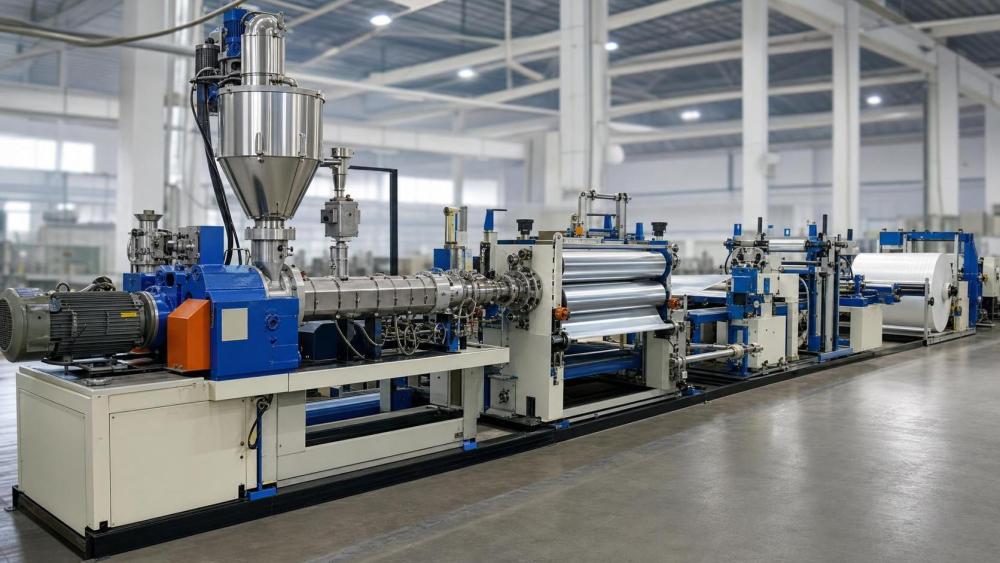
That matters most to procurement teams because sheet lines sit at the intersection of capital cost, production planning, and quality risk. Unlike simple standalone machines, an extrusion line is a chain: feeder, extruder, screen changer, melt pump in some cases, die, calender or polishing stack, cooling, haul-off, trimming, winder or cutter, plus controls and utilities. If one section is mismatched or worn, the cost shows up not only in repair invoices, but in scrap, downtime, labor hours, and delayed customer orders.
Material type changes the cost logic more than many buyers expect
PP, PE, ABS, and PS can all be processed on sheet extrusion equipment, yet they do not put the same demands on the line. Procurement teams often compare lines by width, output, and age first. Those items matter, but resin-specific processing behavior often explains why two visually similar machines carry very different real costs.
PP and PE lines usually raise questions about melt stability, cooling behavior, output consistency, and sheet flatness. ABS and PS bring more attention to thermal control, surface quality, and screw/barrel wear patterns. A line that previously ran GPPS at stable conditions may not be an easy transfer into thicker ABS applications if the temperature control system, drive reserve, roll stack configuration, or venting arrangement is inadequate. The inverse is also true: a line built for more demanding materials may be priced higher used, but require fewer modifications when the buyer needs broader product flexibility.
In practical terms, procurement should ask not only “what materials can this line run,” but “what materials did it actually run, at what thickness range, and under what output conditions?” A machine advertised for multiple polymers may still have a processing history that makes one conversion path much cheaper than another.
The machine’s prior life often matters more than its manufacturing year
Age is easy to compare, so it tends to dominate shortlist discussions. Yet on used equipment, operating history is usually a stronger cost driver than the nameplate year. A twenty-year-old line that ran steady production with disciplined maintenance may be less expensive to own than a newer line exposed to abrasive fillers, repeated overheating, or poor shutdown procedures.
Procurement teams should try to reconstruct the line’s prior life through maintenance logs, spare-part history, photos of wear surfaces, and evidence of previous rebuilds. Areas that deserve close attention include:
- Screw and barrel wear, especially if the line processed filled grades or recycled feedstock
- Die lip condition and history of cleaning damage
- Roll surface quality on calender or polishing stacks
- Gearbox noise, bearing condition, and lubrication records
- Heater bands, thermocouples, and temperature control consistency
- PLC, inverter, and HMI obsolescence
Wear in these areas rarely stays local. A worn screw can reduce melting efficiency and increase energy use. A damaged die lip can force more operator intervention to control gauge profile. Obsolete controls can turn a small fault into extended downtime if replacement parts are hard to source. That is where headline price and true cost separate quickly.
When comparing used sheet extrusion lines, procurement should treat refurbishment scope as part of the acquisition price, not as an afterthought. If a line clearly needs rebuilding before installation, that work belongs in the commercial evaluation from the start.
Output claims should be tested against product mix, not taken at face value
Used line listings often mention nominal output, but those numbers can be misleading without operating context. Output achieved on a narrow product range under favorable conditions does not automatically translate to the buyer’s own mix of sheet thickness, width, resin grade, and surface requirements.
A procurement review should translate output into the buyer’s actual commercial use:
- What sheet width is needed after edge trim?
- What thickness range must the line hold consistently?
- Will the plant run virgin material, regrind blends, or recycled content?
- How tight are gauge tolerances for the end market?
- Is the line expected to change materials frequently?
A machine that performs well at high throughput on thicker commodity sheet may struggle to maintain quality on thinner output or when frequent changeovers are required. Procurement teams that buy only on maximum capacity often discover later that usable capacity, measured at acceptable scrap rate and labor input, is much lower. That gap directly affects cost per ton.
Utility and infrastructure gaps can erase the savings from a cheap line
One of the most overlooked cost drivers is plant compatibility. Used lines rarely move from one factory to another without some adaptation, and those adaptation costs can become substantial. Voltage and frequency differences, chilled water demand, compressed air quality, ventilation needs, floor loading, line length, and upstream/downstream integration all need review before the purchase decision is finalized.
For sheet extrusion, cooling capacity deserves special scrutiny. Even if the extruder is mechanically sound, inadequate temperature control around the rolls, calibrating sections, or downstream cooling can limit output and surface quality. The same applies to material handling. If the buyer’s plant lacks proper drying, blending, or feeding equipment for the intended resin grades, the extrusion line may underperform despite being in acceptable condition.
Procurement should also ask whether the existing electrical architecture can be integrated without rebuilding major sections of the control cabinet. In older European or Asian equipment, parts availability and local service compatibility may influence retrofit cost more than the machine’s mechanical state.
Tooling condition and completeness are major cost drivers
Many buyers focus on the extruder and underestimate the value of tooling that comes with the line. Dies, feed blocks, screen changers, melt pumps, rollers, cutters, winders, and spare sets can materially change the economics of a used purchase. A line sold at a higher upfront price may still offer lower total cost if it includes application-relevant tooling in good condition.
For PP, PE, ABS, and PS sheet, the die is especially important. Even small defects at the die lip can affect thickness distribution and surface appearance. Refurbishment is possible, but lead time and cost should be built into the purchasing model. If the buyer intends to produce multiple widths or structures, the availability of compatible tooling may determine whether the line can support future product plans without another capital event.
Completeness also affects installation timing. Missing small but critical items such as roll-gap indicators, guards, pull rolls, trim systems, shaft sets, or documentation can delay startup more than expected. Procurement documents should identify exactly what is included, what has been removed, and what still needs fabrication or replacement.
Controls, safety upgrades, and compliance work can be expensive
Mechanical inspection is only part of the picture. Older extrusion lines may require electrical modernization, software recovery, safety guarding upgrades, or local compliance adaptation before production can begin. These costs are easy to underestimate because the line may still power on during inspection.
Procurement teams should check:
- Whether PLC and HMI platforms are still supported
- If variable frequency drives are obsolete or difficult to replace locally
- Whether emergency stop circuits and guarding meet current plant requirements
- If wiring diagrams, software backups, and parameter lists are available
- How many sensors, heaters, and controllers are already at end-of-life condition
In many used-equipment projects, controls work is not the largest single line item, but it is often the source of delay. Procurement should ask not only “what must be replaced,” but “what would stop startup if it fails during commissioning?” That is the better way to identify costs that matter to production schedules.
Installation, commissioning, and learning curve costs are real acquisition costs
Second-hand lines are frequently compared as if delivery ends the transaction. For procurement, that is too narrow. Dismantling, packing, ocean or inland transport, customs handling, unloading, reassembly, alignment, utility connection, and trial production all add cost and risk. Even when the machine itself is well priced, project execution can shift the economics.
Commissioning cost depends heavily on how complete the line is and how well documentation travels with it. Missing electrical drawings, undocumented modifications, or unclear piping routes can extend startup by days or weeks. That cost appears in engineering labor, contractor time, and lost production opportunity.
There is also an operational learning curve. Operators familiar with one resin family or one control philosophy may need time to stabilize another line, particularly when moving between PS, ABS, and polyolefin applications. Procurement teams should factor in early scrap, trial material usage, and internal training effort rather than assuming nameplate performance from day one.
Spare parts strategy affects both short-term and long-term cost
A used line can be financially sound even with some wear, provided critical replacement parts are available at reasonable cost and lead time. The problem emerges when a line depends on discontinued control components, proprietary mechanical items, or region-specific parts that are difficult to source.
Before purchase, buyers should identify:
- Critical wear parts likely needed within the first 12 to 24 months
- Whether those parts can be rebuilt locally
- Which components are standard industrial items and which are custom
- Whether spare tooling or backup assemblies are included
This issue is especially relevant when the production schedule is tight and downtime costs more than maintenance itself. A cheaper machine with uncertain spare-part support may expose the plant to far higher business risk than a more expensive line with straightforward serviceability.
A practical way to compare total cost before issuing a purchase order
Procurement decisions improve when buyers move from a single purchase-price comparison to a structured landed-cost model. The aim is not to predict every future expense, but to expose where one line is likely to demand more capital or operating attention than another.
The best procurement outcome usually comes from matching the line to the intended product mix and the plant’s real operating environment, then pricing the missing pieces honestly. A used line for PP, PE, ABS, or PS sheet is not expensive or cheap in isolation. Its true cost depends on how much work remains between “machine available” and “stable output at acceptable scrap rate.” Buyers who evaluate that gap carefully tend to make far better capital decisions than those who focus only on the offer price.
Recommended News