
Search
Category
Related Industries
- China Soda Ash Producer Inventories Fall to 1.3689 Million Tonnes in Week to October 26China soda ash producer inventories fell 6.94% to 1.3689 million tonnes in the week to October 26. Explore what the drawdown means for procurement planning and supplier delivery checks.
- What determines the cost of professional REACH compliance guidance?REACH compliance guidance cost depends on substance complexity, tonnage, data gaps, and support scope. Discover hidden expenses and compare quotes to build a smarter compliance budget.
- China TDI Price Reaches RMB 40,833 per Tonne on October 25, Up 9.38% in 10 DaysChina TDI price reached RMB 40,833 per tonne on October 25, 2026, up 9.38% in 10 days. Explore market trends and procurement cost implications to inform your purchasing decisions.
Weekly Insights
Stay ahead with our curated technology reports delivered every Monday.
How Screw Wear Affects Output Quality in Used Plastic Sheet Extrusion Lines




Screw Wear Is a Quality Issue, Not Just a Throughput Issue
In a sheet extrusion line, the screw is expected to convey polymer, compact the solids, melt the material, build pressure, and deliver a stable melt stream to downstream equipment. When the screw and barrel are worn, the line may still run and may even appear productive during a short trial. Yet the melt condition entering the screen changer, gear pump, or flat die can become less consistent. That inconsistency often appears later as variation in sheet gauge, surface defects, unstable width, poor thermoforming behavior, or a higher scrap rate.
This distinction matters when evaluating a used line. A machine can have an intact frame, functioning drives, and a clean control cabinet while its extrusion unit has lost much of the process stability needed for demanding sheet production. Screw wear should therefore be assessed as a combined mechanical and quality-control risk rather than treated as a routine maintenance item.
For technical evaluators, the central question is not simply whether the screw rotates or whether the line can produce a sample. The more useful question is whether the screw-and-barrel assembly can maintain repeatable output, melt temperature, pressure, and material distribution under the resin grades and operating conditions required by the intended application.
How Wear Changes the Extrusion Process
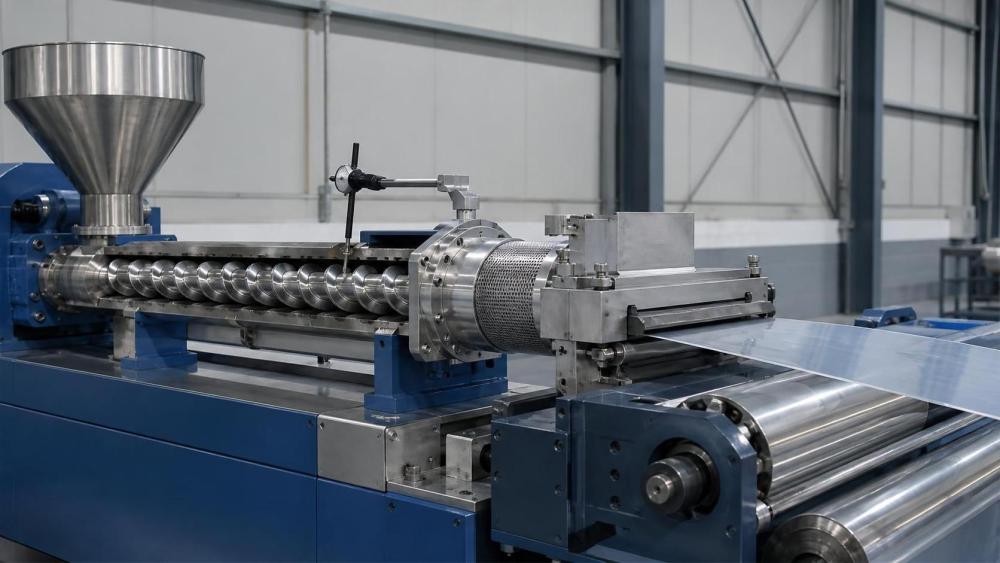
A conventional single-screw extruder relies on a controlled clearance between the screw flights and barrel bore. The screw channels are designed to move polymer forward while limiting backward leakage. As the flight lands wear down, or as the barrel bore enlarges and becomes uneven, this clearance increases. Melt can then flow backward over the screw flights instead of progressing efficiently toward the die.
The result is usually a reduction in volumetric efficiency. At the same screw speed, the extruder may deliver less material than expected, particularly when back pressure rises because of a fine screen pack, restrictive die setting, contaminated material, or a downstream gear pump. Operators may compensate by increasing screw speed, changing barrel temperatures, or raising melt pressure. Those adjustments can restore some output, but they do not restore the original conveying geometry.
Wear also disrupts the balance between solids conveying, melting, and melt pumping. In a healthy screw, these stages overlap in a predictable manner. In a worn system, the position and stability of the melting zone can shift. Pellets or regrind may spend longer in some regions of the barrel and pass too quickly through others. The extrudate may then contain material with uneven thermal and shear histories.
For sheet production, this can be more serious than a straightforward loss of kilograms per hour. Flat sheet demands a consistent melt curtain across the die width. Small changes in pressure, viscosity, or temperature can influence die flow distribution and alter the sheet profile. A process that is acceptable for a thick, non-critical sheet may be unsuitable for thin-gauge packaging sheet, high-gloss surface applications, multilayer structures, or sheet intended for subsequent thermoforming.
Quality Symptoms That Can Point to Screw or Barrel Wear
No single defect confirms screw wear. Similar symptoms can be caused by resin moisture, poor temperature control, a restricted screen pack, damaged heaters, incorrect die adjustments, or unstable haul-off conditions. Still, a cluster of process symptoms should trigger closer mechanical inspection.
Pressure behavior is often especially informative. A stable extrusion process typically shows a reasonably repeatable relationship between screw speed, melt temperature, and pressure after the line has reached thermal equilibrium. If pressure wanders while feed rate, temperatures, and downstream speed remain steady, the cause may lie in the screw-barrel system or another melt-flow restriction. The pattern should be investigated rather than corrected only by operator adjustments.
Why Resin Type Changes the Risk Assessment
Used sheet lines may have processed PP, PE, ABS, PS, recycled blends, filled compounds, or a changing mix of materials over their service life. That history affects both the likely wear mechanism and the relevance of observed wear.
PP and PE generally place different demands on screw design because their melting and conveying behavior differ. A screw that has operated acceptably with one grade may not give the same melt stability with another, especially if the line is being reassigned to a different product family. ABS and PS sheet processing can place greater emphasis on thermal control, melt homogeneity, and surface appearance. In these applications, an extruder that produces nominal output may still cause issues if it creates temperature variation, gels, degraded material, or unstable pressure.
Filled materials, mineral-loaded compounds, and some recycled streams can accelerate abrasive wear. Regrind may introduce contamination or material variability that makes an already worn screw more difficult to diagnose. If the previous operating history is incomplete, evaluators should avoid assuming that a screw was used only with virgin resin or low-abrasion grades. The screw geometry, barrel condition, filter arrangement, and available maintenance records collectively provide a more reliable picture.
Wear Is Often a Screw-and-Barrel Problem
Inspecting the screw alone can be misleading. A screw with visibly rounded flight lands may clearly need attention, but a screw that appears acceptable can still operate poorly inside an oversized or locally worn barrel. Wear frequently concentrates in zones exposed to high pressure, high solids friction, or abrasive feedstock. The feed zone, compression section, and metering section may not wear at the same rate.
For this reason, screw outside diameter and barrel inside diameter should be assessed as a matched system. Measurements taken at several axial positions and around the circumference are more useful than one reading near an accessible end. A localized barrel enlargement can create a process problem even if average dimensions appear tolerable. The evaluation should also consider barrel scoring, corrosion, pitting, signs of overheating, and the condition of any bimetallic liner.
Flight wear can take several forms. Uniform reduction in flight diameter generally points to gradual service wear. Uneven flight loss, sharp grooves, or local damage may indicate foreign-metal contact, poor alignment, bearing issues, or a past process upset. Blueing or discoloration can suggest overheating, though its interpretation depends on material and service history. These findings should lead to questions about root cause, not merely a decision to polish or recoat the screw.
Inspection Before Purchase Should Combine Records, Measurement, and a Running Trial
When comparing used plastic sheet extrusion lines, the extrusion unit deserves the same level of scrutiny as the die, calendar rolls, winding section, and electrical controls. The practical objective is to determine whether the existing screw-barrel condition supports the required product window or whether refurbishment must be included in the acquisition plan.
Documentation can provide useful context, although it should not replace inspection. Maintenance records may indicate whether the screw was rebuilt, whether the barrel was relined, when heaters or thermocouples were replaced, and which materials were processed. Records of previous output, common defects, screen-change frequency, or drive load may also help identify questions for the trial run. Missing records do not automatically disqualify a line, but they increase the value of direct measurement and longer observation.
Cold Inspection Priorities
- Confirm the screw type, nominal diameter, length-to-diameter ratio, and available screw drawings where possible.
- Inspect flight lands for rounding, cracks, chipping, welded repairs, and inconsistent geometry between zones.
- Measure screw dimensions and barrel bore condition using methods appropriate to the machine size and accessibility.
- Check thrust bearing condition, gearbox history, coupling alignment, and signs of oil leakage or abnormal vibration.
- Inspect barrel heating and cooling zones, including sensor placement and evidence of damaged insulation or wiring.
- Review the condition of the hopper, feed throat cooling arrangement, vacuum venting equipment if fitted, and melt filtration components.
A removed screw allows a far more meaningful inspection than an external visual check. If removal is not possible before purchase, the limits of the assessment should be recorded clearly. A bore-scope inspection may reveal scoring or deposits, but it cannot substitute for dimensional verification when wear risk is material to the project.
What a Useful Production Trial Looks Like
A short startup run can conceal problems because temperatures are still stabilizing and material residence time is limited. A more useful trial allows the barrel, screw, die, and rolls to reach steady conditions. It should use a resin grade close to the planned production material whenever feasible. The evaluator can then observe output consistency, drive load, melt pressure behavior, actual temperature readings, sheet gauge stability, edge trim behavior, and surface appearance over time.
Changing screw speed in controlled steps can reveal whether output rises predictably or whether pressure becomes erratic. The purpose is not to force the line to its maximum possible rate. Running a worn machine beyond a stable operating window can create excessive melt temperature, material degradation, and misleading results. A line should be judged against the intended sheet specification and practical operating margin, not its brief ability to make an acceptable sample at one setting.
Separating Screw Wear from Downstream Causes
Sheet defects often originate after the extruder. A damaged die lip can produce persistent transverse or longitudinal gauge patterns. Contaminated or worn rolls can mark the sheet surface. Roll-temperature imbalance may create curl, uneven cooling, or gloss variation. Winder tension problems can distort the finished roll without affecting melt quality.
Technical assessment is more reliable when symptoms are traced in process order. Start with material handling and drying where relevant, then examine feed consistency, barrel temperatures, screw speed, motor load, melt pressure, filtration, die behavior, roll settings, and winding. If a gauge problem changes with melt pressure or screw-speed variation while die settings remain fixed, the extruder becomes a stronger suspect. If the defect stays in the same cross-web location regardless of output changes, die or roll conditions may be more likely.
Where a gear pump is installed, it can reduce some short-term output variation by metering melt more consistently. It does not eliminate the consequences of severe upstream wear. An unstable or poorly homogenized melt still reaches the pump, and excessive upstream pressure demand can limit the practical operating range. Similarly, a screen changer may capture contaminants but cannot correct a screw that is no longer providing adequate melting or pressure development.
Refurbishment Decisions Need a Process-Based Cost View
Repair options can include screw rebuilding, hardfacing, re-machining, replacement, barrel relining, or barrel replacement. The appropriate option depends on the original metallurgy, wear pattern, remaining dimensions, target resin, and required output quality. A repair that restores flight diameter without addressing a worn barrel may provide limited benefit. Conversely, replacing a screw without confirming barrel geometry can leave the same leakage problem in place.
The cost decision should include more than the repair invoice. Technical evaluators should account for removal and installation work, alignment checks, recommissioning time, process validation, potential die cleaning, and the production risk of operating until failure. A lower purchase price can lose its advantage if the line requires immediate screw-barrel work, suffers recurring gauge variation, or cannot run the intended recycled-content formulation without excessive scrap.
Wear is not automatically a reason to reject a used line. A line with documented wear, a realistic refurbishment scope, and sufficient downstream capability may be a sound fit for certain products. The problem arises when wear is treated as unknown or when a trial run is interpreted without considering material history, measurement results, and the sheet quality required after installation. For extrusion equipment, repeatable melt delivery is the foundation of repeatable sheet quality, and screw condition remains one of the clearest indicators of whether that foundation is intact.
Recommended News