
Search
Category
Related Industries
- China Soda Ash Producer Inventories Fall to 1.3689 Million Tonnes in Week to October 26China soda ash producer inventories fell 6.94% to 1.3689 million tonnes in the week to October 26. Explore what the drawdown means for procurement planning and supplier delivery checks.
- What determines the cost of professional REACH compliance guidance?REACH compliance guidance cost depends on substance complexity, tonnage, data gaps, and support scope. Discover hidden expenses and compare quotes to build a smarter compliance budget.
- China TDI Price Reaches RMB 40,833 per Tonne on October 25, Up 9.38% in 10 DaysChina TDI price reached RMB 40,833 per tonne on October 25, 2026, up 9.38% in 10 days. Explore market trends and procurement cost implications to inform your purchasing decisions.
Weekly Insights
Stay ahead with our curated technology reports delivered every Monday.
How Open-Top Fermentation Tanks Affect Cleaning, Yield, and Flavor Control




How Open-Top Fermentation Tanks Affect Cleaning, Yield, and Flavor Control
In distilling, fermentation is often discussed in terms of raw materials, yeast selection, and temperature control, yet vessel design has an equally practical influence on daily performance. Open-top fermentation tanks remain relevant in many spirits operations because they allow operators to observe activity directly, manage cap formation more easily, and adapt the process to styles that depend on close monitoring. For production teams, however, the choice is rarely only about tradition or accessibility. It affects cleaning routines, process consistency, alcohol recovery, contamination risk, and the final sensory profile that reaches the still and, ultimately, the bottle.
This matters more today because distilleries are under pressure from several directions at once. Many are expected to improve throughput without compromising character. Quality teams are asked to reduce variation lot to lot. Maintenance staff are expected to keep equipment sanitary and available with limited downtime. At the same time, buyers comparing fermentation systems are no longer looking only at tank volume or purchase price. They are increasingly evaluating how a vessel fits into the broader realities of cleaning labor, production scheduling, flavor objectives, and long-term serviceability.
Open-top tank design can be especially significant in agave spirits, rum, grain distillates, and other categories where fermentation behavior is visibly active and where manual intervention still plays an important role in some facilities. The open configuration may support operator awareness, but it also requires tighter discipline in sanitation, environmental control, and process management. That tradeoff is what makes the selection question more technical than it may first appear.
Why Cleaning Performance Starts with Tank Geometry
Cleaning is often treated as a downstream task, but in fermentation it is a design issue from the beginning. An open-top vessel changes how residue is removed, how surfaces are inspected, and how quickly a tank can return to service. Direct physical access is one of the clearest operational advantages. Operators can visually check corners, weld areas, and product-contact surfaces without relying entirely on indirect verification. This may be helpful when fermenting viscous mash, fibrous raw materials, or solids-heavy media that leave residue above the liquid line.
That said, easy access does not automatically mean easy sanitation. Open tops expose the vessel to the surrounding room, so airborne particles, insects in poorly controlled environments, condensate, and operator contact become more relevant risks. Cleaning quality therefore depends not only on the tank itself but on plant hygiene discipline, ventilation conditions, cleaning standardization, and how consistently staff follow post-clean inspection routines. A tank that is simple to scrub but difficult to protect between batches may still create quality losses.
For maintenance and sanitation teams, a useful selection question is whether the vessel supports repeatable cleaning under actual operating conditions rather than ideal ones. Smooth internal finishes, practical drain design, accessible outlet connections, and a layout that avoids residue traps can matter more than a basic specification sheet suggests. If the process includes thick cap formation or sticky organic buildup, the ability to clean manually and verify cleanliness visually may shorten troubleshooting time when compared with systems that hide problem areas.
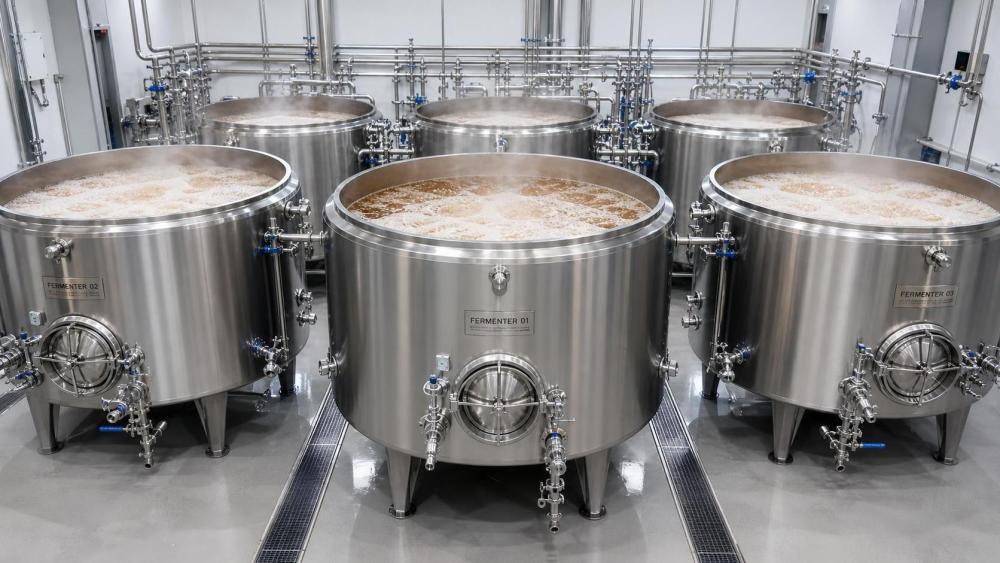
From a safety and quality perspective, open configurations also shift more responsibility to procedures. Teams should pay attention to how cleaning chemicals are handled around exposed tank openings, whether splash risks are controlled, and how cleaned vessels are protected before refilling. In many facilities, the true sanitation outcome depends on the interaction among vessel design, cleaning chemistry, water availability, drainage, and staff training rather than on any single equipment feature.
How Yield Can Be Helped or Hurt by an Open-Top Setup
Yield is often discussed only in terms of sugar conversion efficiency, but tank type can influence multiple hidden losses. In open-top fermentation, exposure to ambient conditions may affect temperature stability, evaporation, and microbial competition. These factors can influence how efficiently fermentable sugars are converted into alcohol and desirable flavor compounds. If heat buildup is not managed well, yeast stress may increase. If the fermentation environment is less controlled, spoilage organisms may consume sugars or generate unwanted acids that reduce usable output.
On the other hand, some distilleries find that open access supports better process intervention. Operators can break caps, skim foam when necessary, assess fermentation vigor directly, and respond quickly to abnormal visual signs. In operations where raw material variability is common, that level of visibility may help preserve yield by allowing faster corrective action. The practical value depends on whether the team has the experience and staffing to turn visibility into disciplined process control.
When procurement teams assess open-top distillery fermentation tanks, the most useful comparison is rarely a simple open-versus-closed judgment. A better approach is to examine expected fermentation style, room conditions, raw material behavior, and available labor for supervision and sanitation. In some plants, the open format supports stable output because operators can manage active fermentations more effectively. In others, the same design may increase variability if environmental control and hygiene execution are weak.
Another yield consideration is downtime between batches. Tanks that are faster to inspect, clean, and refill may improve overall plant utilization even if batch-level fermentation performance is similar. For many distilleries, annual output depends as much on turnaround efficiency as on theoretical conversion rates. This is why a selection guide for fermentation and holding tanks should consider full operating rhythm, not just vessel capacity.
Flavor Control Is Where Design Choices Become Most Visible
Flavor control is often the reason open-top tanks remain part of distillery practice. In certain spirit categories, producers value the ability to observe aroma development, foam structure, surface activity, and cap behavior in real time. This visibility can shape decisions about agitation, fermentation duration, and when to transfer wash for distillation. For experienced operators, those cues are not cosmetic details; they can be part of the sensory and technical judgment used to steer house style.
Open tanks may also encourage a more dynamic microbial environment, which can be beneficial or problematic depending on the product target. In some fermentation styles, a slightly less isolated system may contribute to complexity. In other cases, it may increase the chance of uncontrolled acid formation, off-notes, or batch drift. The right balance depends on whether the brand strategy favors tightly standardized output or accepts a measured degree of natural variation as part of the product identity.
Temperature interaction is another important point. Because the top is exposed, heat exchange and surface cooling may behave differently than in sealed systems. If this effect is not integrated into the fermentation plan, flavor development can become inconsistent. Even when tanks are built from suitable materials and sized appropriately, the surrounding room environment still influences the result. Quality teams should therefore review vessel choice together with temperature management capability rather than treating them as separate decisions.
Key Questions for Users, Quality Teams, and Maintenance Staff
For operators and supervisors, the first question is whether the tank supports the actual production method used on site. A vessel that is ideal for heavily monitored artisanal fermentation may not fit a plant that depends on highly standardized, low-touch batch control. Teams should evaluate the expected mash type, solids load, foaming tendency, cleaning frequency, and the degree of operator intervention built into normal work instructions.
For quality and safety personnel, the core concern is control of contamination and repeatability. Open-top systems require attention to room hygiene, sanitation verification, transfer timing, and exposure management during and after cleaning. This does not automatically make them unsuitable. It simply means the quality system must match the vessel concept. Facilities that do this well often combine visible access with strict environmental discipline and clear sanitation checkpoints.
For after-sales and maintenance teams, durability and maintainability deserve equal weight. Tank surfaces should be practical to inspect, repair, and keep in sanitary condition over time. Fittings, valves, drains, and weld zones should not create recurring service issues. Where spare parts, technical support, or replacement components are hard to obtain, even a well-designed vessel can become a weak link in operations. Buyers should therefore look beyond initial performance claims and consider service life under repetitive cleaning and production cycles.
A Practical Selection Framework for Fermentation and Holding Tanks
A useful selection process starts with function, not format. Distilleries should first define whether the tank will be used only for active fermentation, for short holding after fermentation, or for both roles in sequence. Holding requirements may change how teams think about exposure time, transfer logistics, and sanitation timing. Material compatibility, outlet placement, drain efficiency, and cleaning accessibility should then be reviewed against the actual liquid or mash characteristics being processed.
It is also sensible to compare labor assumptions. An open-top system may be operationally effective in a plant where skilled staff monitor fermentation closely across each shift. In a facility with limited hands-on supervision, a more enclosed and automated approach may reduce inconsistency. Neither option is universally better. The better choice is the one that aligns with staffing reality, quality expectations, and the desired flavor profile.
Procurement teams may benefit from reviewing tanks through three linked lenses: sanitation reliability, process yield, and flavor control. If one of these is optimized at the expense of the others, the apparent savings may disappear later in the form of rework, downtime, product loss, or style inconsistency. This is especially relevant in distilling, where fermentation is not an isolated step but a major driver of what the still receives.
Conclusion
Open-top fermentation tanks remain important because they can support direct observation, practical intervention, and process styles that value close operator control. Their impact on cleaning, yield, and flavor is real, but it is never determined by vessel design alone. Results depend on how the tank interacts with raw materials, sanitation routines, room conditions, staffing capability, and the production goals of the distillery.
For distilleries reviewing fermentation and holding tank options, the strongest decisions usually come from evaluating everyday operating consequences rather than comparing only headline specifications. When cleaning discipline, yield targets, and flavor objectives are assessed together, open-top systems can be judged on their true production value instead of on assumption or habit.
Recommended News